How Do AI Influencers Make Money? Six Paths and the $200 Median
AI influencers earn from Fanvue subscriptions and DMs at an 80% share, brand deals, affiliate links and DM funnels. The median creator clears under $200 a month, the top $20,000.
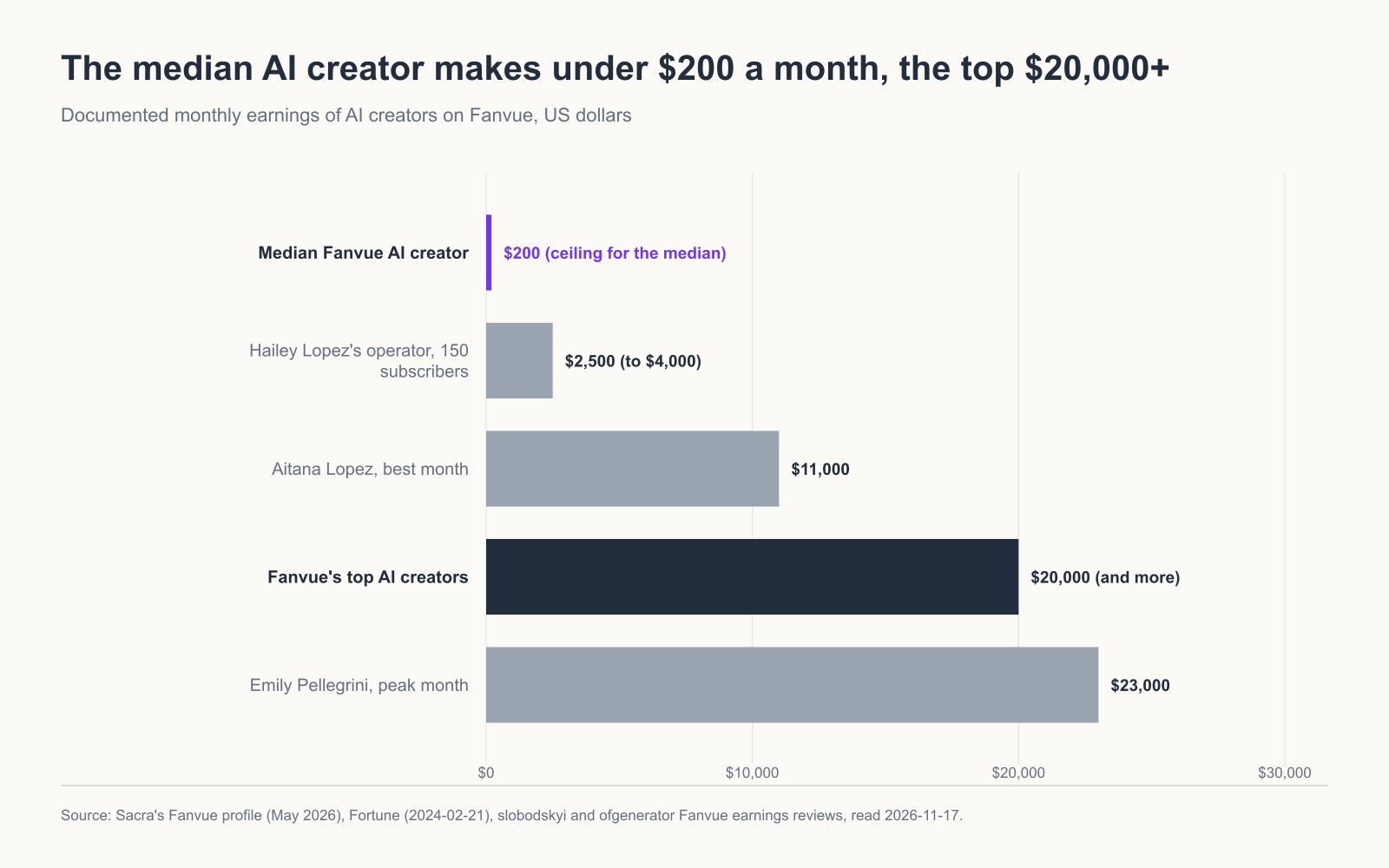
AI influencers make money six ways, and the bio link tells you which one an account runs. Subscriptions and paid DMs on Fanvue, where the creator keeps 80% and AI creators are about 15% of platform revenue. Brand deals and licensing. TikTok Shop and Amazon affiliate links. DM funnels into digital products. Selling the build to other operators. Platform payouts, which most AI accounts never see. The spread is steep: Fanvue’s top AI creators clear $20,000 a month, and the median AI creator clears under $200.
The question is live. In the 1,227 Reddit posts we pulled from the last 30 days, 37 threads are about AI influencers and 30 of them ask about money. On X, the most liked and most bookmarked post in our 480-post corpus is a $300-a-month stack for running an AI grandmother who sells vitamins. Below: each path as a mechanism with its take rate, and why a brand should own the character.
Key findings
- The median AI creator on Fanvue clears under $200 a month, the top AI creators clear $20,000 and more, and Emily Pellegrini’s best month was $23,000.
- Fanvue pays creators 80% of every subscription, paid message and tip, and AI creators were about 15% of revenue as it passed $200M in ARR in 2026.
- In a creator’s first two months on Fanvue, subscriptions are around 10% of earnings and paid DMs around 60%, by Fanvue’s own numbers.
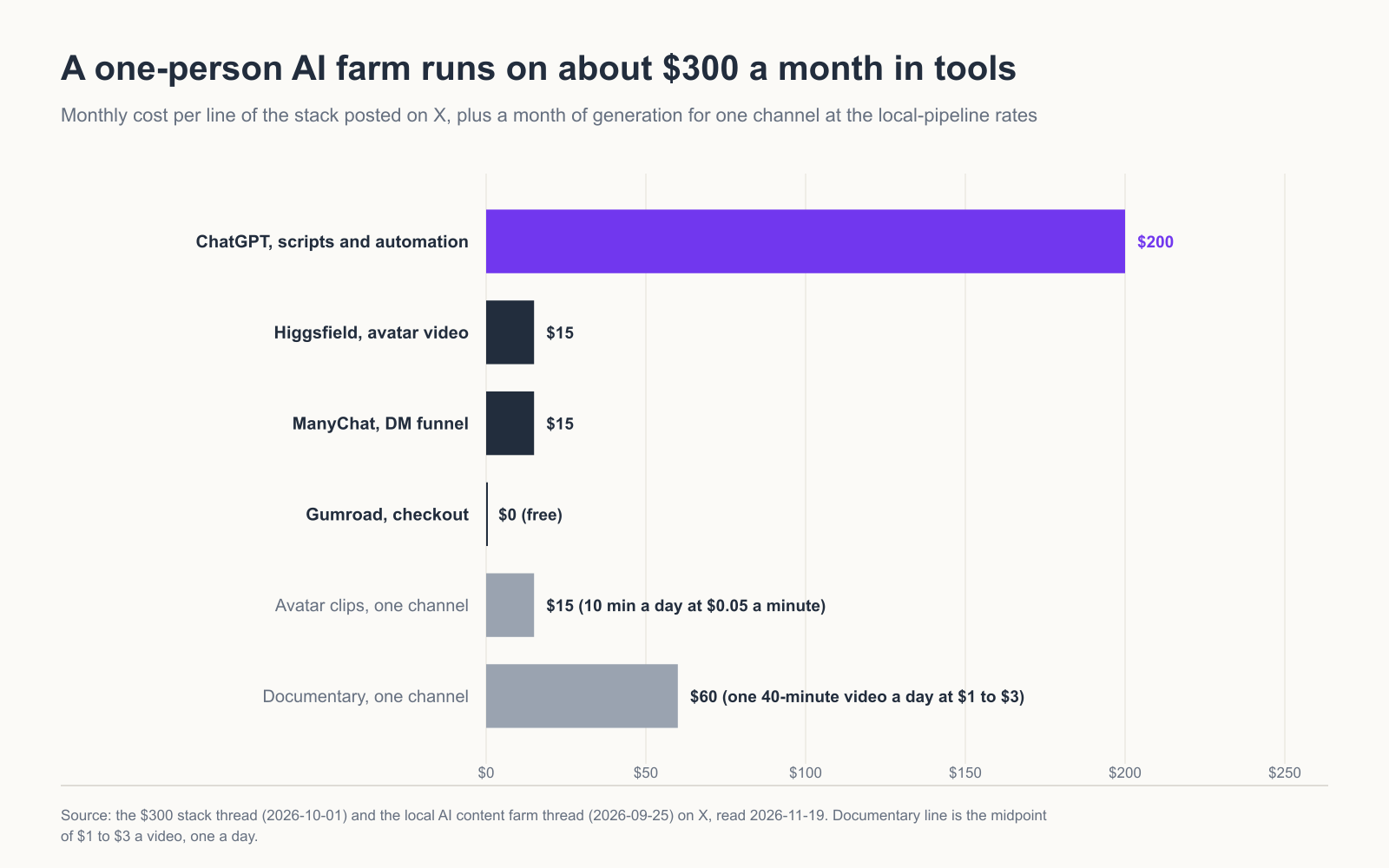
- Three published starter stacks run from $25 to $300 a month, and the $300 version is ChatGPT $200, Higgsfield $15, ManyChat $15 and Gumroad free.
- Amazon pays 1% on health and personal care, where the vitamin grandma sells, against about 13% on an average TikTok Shop affiliate link.
- 50 of the 480 X posts in our corpus close with a comment-keyword DM hook, the hand-off from feed to product.
What is an AI influencer?
An AI influencer is a character that does not exist, with a generated face, voice and personality that stay consistent from post to post, posting on social platforms like any creator and earning money the same ways a human creator does.
liambraus put it the same way to 147,000 viewers on X: “a character that doesn’t exist, but has its own face, style and personality, and posts like any other creator.” TIME’s profile of Granny Spills describes two creators at Blur Studios who took a pink-suited AI grandmother to 1 million Instagram followers and 400,000 TikTok followers in her first few weeks.
The format has moved past the glamour niche. Claudia, launched on X as “the first AI influencer”, drew 3.6 million views on the announcement. Kiyomi, an AI recipe influencer, has 39,000 Instagram followers and a recipe site with a cookbook and Amazon affiliate products. Audiences now ask which hosts are human, as an r/isthisAI thread about a TikTok host shows. How operators keep the face consistent is covered in our post on the character pipeline.
How do AI influencers make money?
AI influencers make money six ways: subscriptions and paid DMs on Fanvue at an 80% creator share, brand deals and licensing of the character, TikTok Shop and Amazon affiliate commissions on tracked sales, DM funnels that send a follower to a Gumroad product, selling the build itself as a course, a service or a tool, and platform payouts, which exclude most AI content.
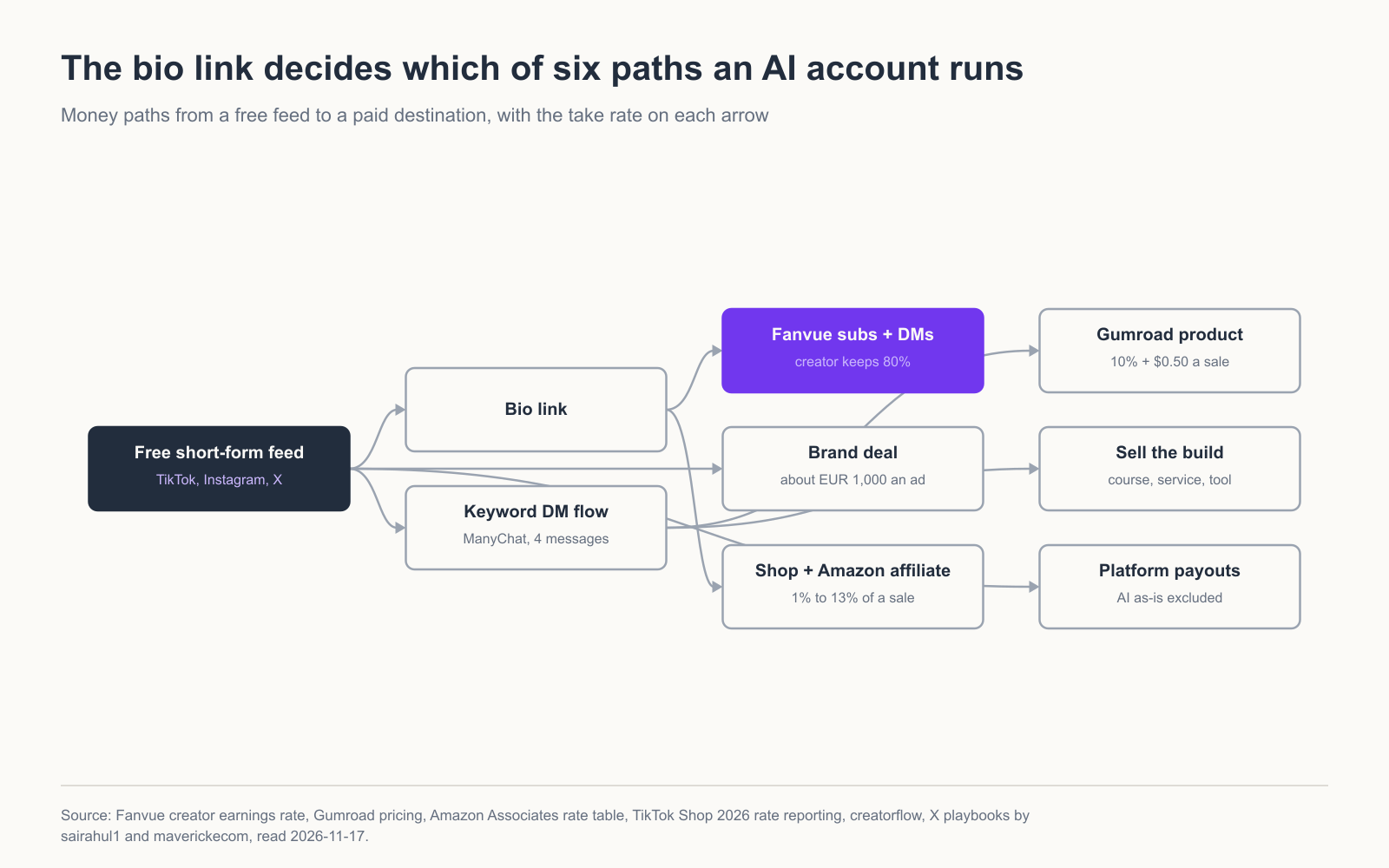
Figure 1. The money paths from a free feed to a paid destination, with the take rate on each arrow.
The first path is the one the r/AIIncomeLab breakdown calls the business model: build an audience for the persona on free platforms, then “move the most engaged followers to a paid subscription page.” The paid page is Fanvue, because most creator sites ban fully synthetic personas. Fanvue’s AI content rules permit fully AI characters under an AI label, and its standard creator earning rate is 80% across subscriptions, pay-per-view messages, tips and one-off purchases.
Fanvue’s own Subscription Pricing and Retention Guide says that in a creator’s first two months the subscription is around 10% of earnings and paid messages in DMs around 60%.
| Path | Who pays | Take rate for the operator |
|---|---|---|
| Fanvue subscriptions and paid DMs | Fans | 80% of every payment |
| Brand deals and licensing | Brands | A negotiated fee, about EUR 1,000 an ad for Aitana |
| TikTok Shop affiliate | Sellers | About 13% of a tracked sale on average |
| Amazon affiliate | Amazon | 1% to 10% by category |
| DM funnel to a Gumroad product | Followers | Sale price less 10% plus $0.50 |
| Selling the build | Other operators | Course, service or tool price |
| Platform payouts | TikTok, YouTube, Meta | Mostly excluded for AI posted as-is |
The second path is brand money. creatorflow’s roundup of verified earnings puts Aitana at about EUR 1,000 per advert and roughly EUR 3,000 in an average month.
The third path is affiliate commission, and the rate card picks the product. The most liked post in our X corpus runs an AI grandmother who sells to women in their 60s on TikTok Shop and ends every video on “the yellow basket icon.” Amazon’s standard commission table pays 1% on health and personal care, 3% on beauty, 4% on most other categories, 4.5% on kitchen and 10% on luxury beauty. The average US TikTok Shop affiliate commission is about 13%, with beauty and wellness at 14% to 25% and open collaboration at 10% to 15%. A vitamin sold through the yellow basket pays the grandma about thirteen times what the same bottle pays through an Amazon link.
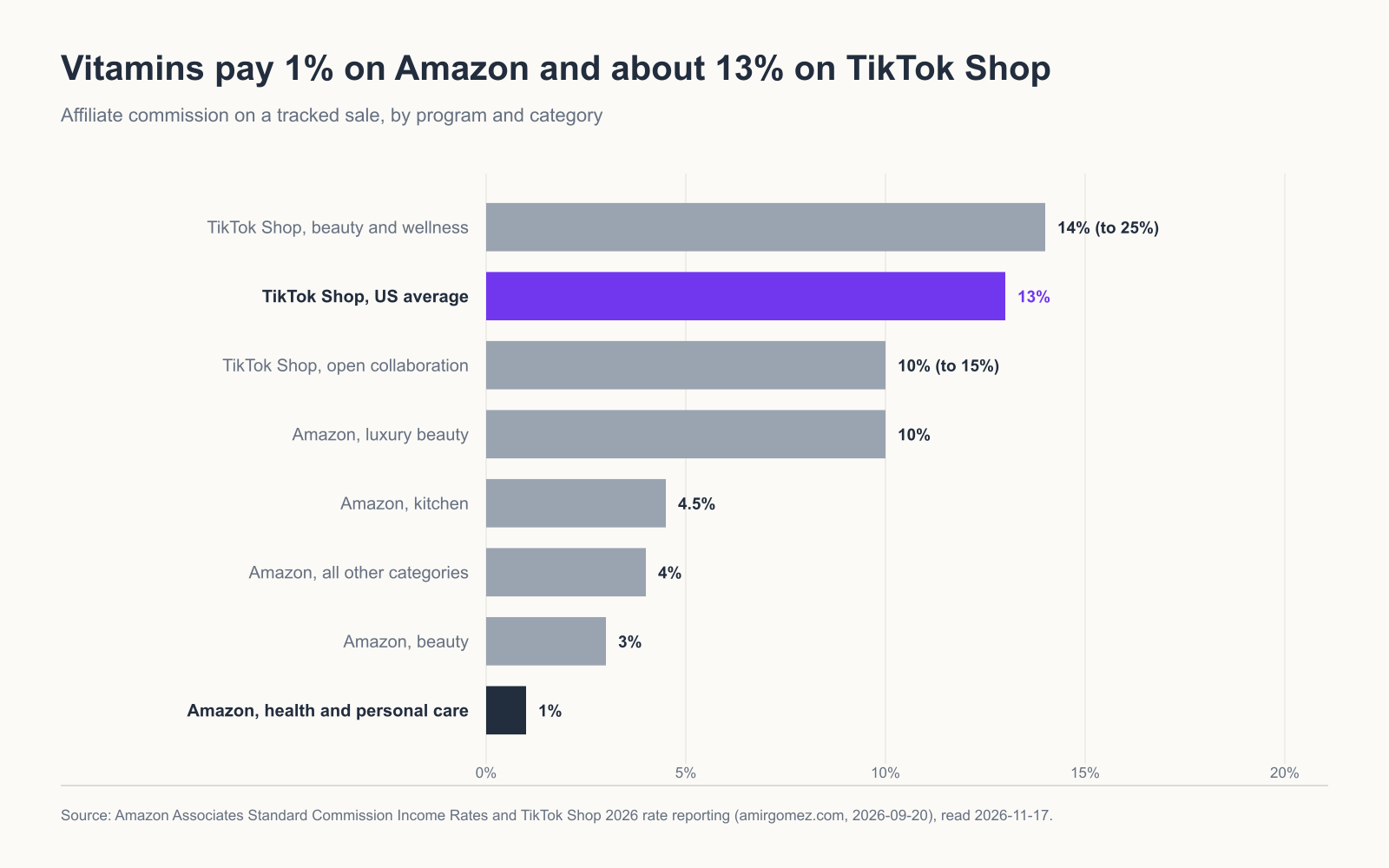
Figure 2. Affiliate commission on a tracked sale, by program and category.
The fourth path is the DM funnel. The grandma playbook sets a ManyChat trigger keyword “tied to a 4-message DM flow ending in your tiktok shop affiliate link” and claims a 31% to 41% click-through against 4% for email. maverickecom’s Instagram version gives away an ebook with an Amazon link inside. The product sits on Gumroad, which charges 10% plus $0.50 per direct sale and no monthly fee. 50 of the 480 X posts we pulled close with “comment X and I’ll DM you.”
The fifth path is selling the build. All three Reddit playbooks close by offering a course for a comment, and at the top of this market the course is the product, which we size in our post on AI content farm economics.
The sixth path barely exists for AI accounts. TIME reports Granny Spills’ TikTok videos were flagged as “unoriginal” and dropped from the Creator Rewards Program at 400,000 followers. The rules by platform are in our post on AI content monetization rules.
How much do AI influencers earn?
AI influencers earn from under $200 a month at the median to $20,000 and more a month at the top of Fanvue, where AI creators are about 15% of a platform that passed $200M in ARR. Emily Pellegrini peaked at $23,000 in a January, Aitana at $11,000 in one month, and a 150-subscriber operator earns $2,500 to $4,000.
Figure 3. Documented monthly earnings of AI creators on Fanvue, in US dollars.
The platform numbers come from Sacra’s Fanvue profile: $200M in ARR in 2026, AI creators at “approximately 15% of total platform revenues,” top AI performers “generating $20,000+ monthly,” and a 20% cut on creator earnings. The named cases, Emily Pellegrini’s $23,000, Aitana’s $11,000 month and Hailey Lopez’s operator at $2,500 to $4,000, come from Fortune.
The floor comes from operator reviews. ofgenerator’s Fanvue breakdown runs from $0 to $500 a month in months one to three up to $10,000 to $60,000 for teams. The slobodskyi review puts the median AI creator under $200 a month and 60% to 70% of revenue in pay-per-view messages and tips.
The curve is steep because the revenue is labour: someone, or something, answering DMs in character for hours a day. The r/wifimoolah playbook does the funnel math: at a $10 subscription, $1,000 a month is about 100 subscribers, which is “a few thousand engaged followers,” because follower-to-subscriber conversion is “low single digits.”
What does it cost to start an AI influencer?
Starting an AI influencer costs between $25 and $300 a month in tools, depending on whether the account sells subscriptions or products. The itemised r/AIIncomeLab thread puts the bare minimum at $25 to $40 and a comfortable stack at $80 to $120. The TikTok Shop grandma playbook runs $300: ChatGPT $200, Higgsfield $15, ManyChat $15, Gumroad free.
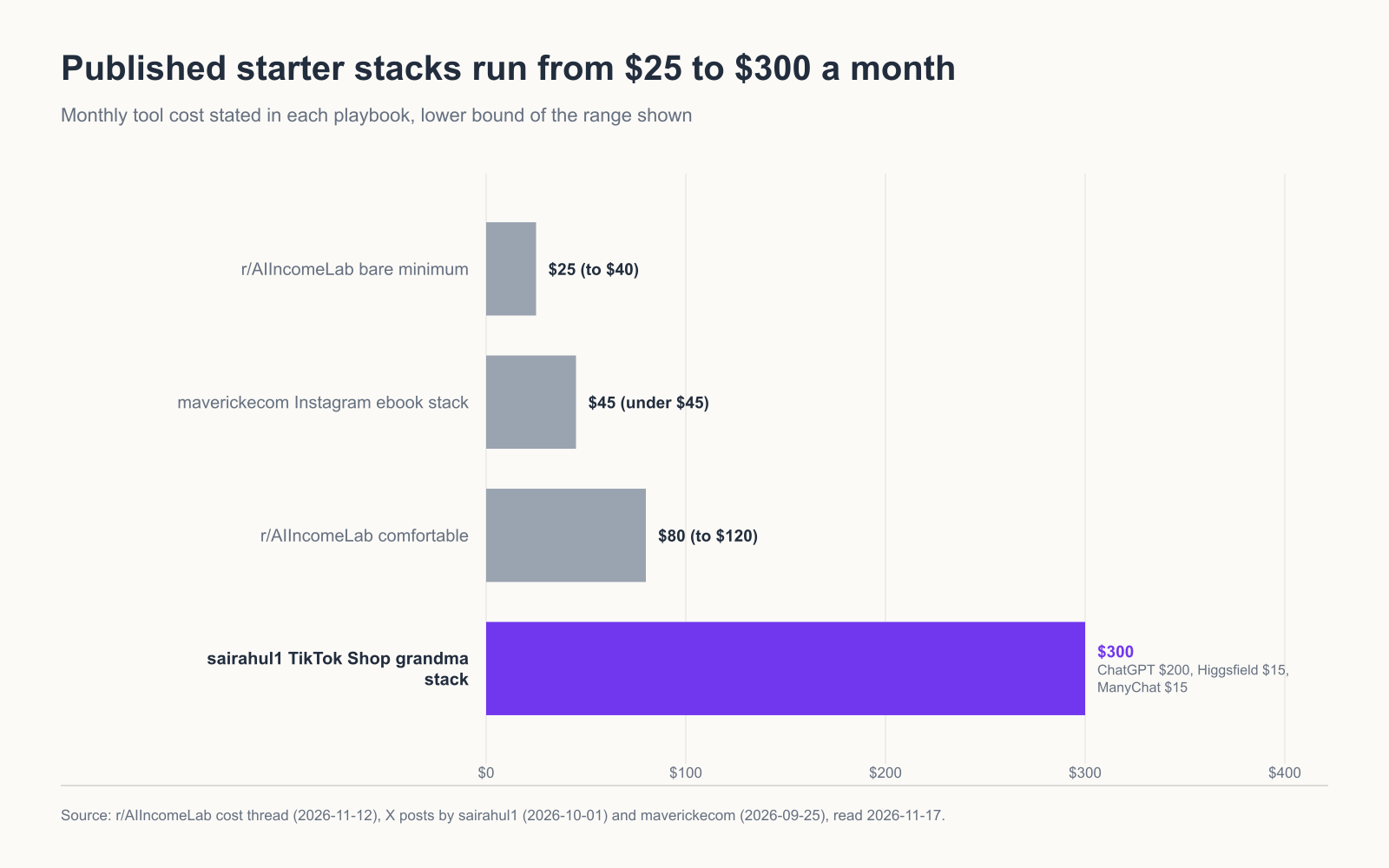
Figure 4. Monthly tool cost stated in each playbook, lower bound of the range shown.
The r/AIIncomeLab cost thread, 105 comments, was written to end the argument between “$0 bro” and “$2k minimum.” Its line items and the grandma playbook’s are the two columns below. maverickecom’s Instagram ebook stack sits between them at “under $45/month in tools.”
| Line item | Subscription stack (r/AIIncomeLab) | Product stack (sairahul1) |
|---|---|---|
| Images and video with a consistent face | $20 to $80 (Higgsfield from $15) | Higgsfield $15 |
| Voice | $22 (ElevenLabs), skipped until talking content | Not listed |
| Scripting and automation | $0, manual | ChatGPT $200 |
| DM automation | $0, manual replies | ManyChat $15 |
| Checkout | Fanvue, 20% of each payment | Gumroad, free plus 10% and $0.50 a sale |
| Monthly total | $25 to $40 minimum, $80 to $120 comfortable | $300 |
The cost nobody lists is time. The thread budgets one to two weeks to lock a consistent face, then one to two hours a day posting and replying, and tells readers to “budget about $100/mo for 3 months and treat it as tuition.”
How do AI influencers get traffic?
AI influencers get traffic from free short-form feeds: TikTok and Instagram do the reach, the bio link or a comment keyword does the hand-off, and the paid platform or product does the conversion. The grandma playbook posts six videos a day and expects one or two winners by video 100. Instagram’s AI-generated profile label is mandatory for these accounts and leaves reach unchanged.
The traffic engine is a posting schedule. The grandma playbook warms the account for 14 days before the first AI video, then automates six posts a day and duplicates the one or two winners “30x.” This is the posting engine behind our faceless account programs: three to five posts a day, no one on camera, on accounts the brand owns. Granny Spills shows the ceiling: an X breakdown counted 2.1 million Instagram followers from 240 posts, and a tracker read 10.84 million views in 30 days in September 2026.
The label is part of the engine. On August 31, 2026 Instagram renamed its AI creator label to “AI-generated profile” and wrote the rule down: “Creators who proactively add the AI-generated profile label will not see a change to their profile’s reach,” while unlabeled AI profiles lose recommendations. Fanvue’s labels and disclosure rules run the same way: every account with AI-generated content carries an account-level label, and a creator asked “Are you AI?” must answer yes. The label costs nothing. Hiding it costs reach.
Should a brand run its own AI influencer?
A brand should run its own AI influencer when it owns the character, because the mechanics are the same whether a creator or a brand runs them, and a brand already has the product the funnel needs, so it skips the 20% platform cut, the 1% to 13% affiliate rate and the course at the end. It adds the AI label and a consistent face.
Renting is the alternative, and the rate card argues against it. Aitana’s operators charge about EUR 1,000 per advert, and whether to hire one is already a question on r/influencermarketing. A rented AI influencer carries someone else’s disclosure, platform exposure and sponsors.
An owned character is a presenter, not a fake person, and that changes the trust math. creatorflow’s roundup cites the detection penalty: when people realise a creator is AI, 31% trust the brand less and 7% trust it more. The accounts that keep growing say so up front. The character is a distribution asset the owner controls, which is the shape of our face-of-brand programs: a brand-owned character that fronts the brand’s content, labelled as AI from the first post, with the product at the end of the funnel instead of a subscription page.
A decision table for brands weighing an AI character
| Question | Rent a creator’s AI influencer | Build a brand-owned character |
|---|---|---|
| What is at the end of the funnel? | Their subscription page or course | Your product, your site, your list |
| Who keeps the margin? | About EUR 1,000 per advert to the operator | 100% of the sale, no 20% platform fee |
| Who controls disclosure? | The operator, under their label | You, with the AI-generated profile label on from day one |
| What happens when a platform changes a rule? | Their account takes the hit | You move the character, keep the asset |
Hi Violet designs and runs brand-owned characters end to end: the character bible, the locked face, the posting engine and the funnel to the brand’s own product, labelled as AI from the first post. That is our face-of-brand work, on the same posting engine as our faceless account programs. To own the character, request a strategy call.
How we did it
We pulled 480 X posts from 2026-09-01 to 2026-11-17 across eight searches through Apify’s tweet scraper by apidojo, and 1,227 Reddit posts from the last 30 days across 43 searches through Apify’s Reddit scraper by harshmaur. We counted 37 Reddit threads about AI influencers, 30 of them about money, and 50 X posts that close with a comment-keyword DM hook, and ranked all 480 X posts by likes and bookmarks. On 2026-11-17 we read Fanvue’s AI rules and pricing guide, Sacra’s Fanvue profile, Fortune, TIME, Instagram’s label post, Amazon’s commission rates, Gumroad’s pricing and the operator breakdowns linked above.
FAQ
How do AI influencers make money?
Six ways: Fanvue subscriptions and paid DMs at an 80% creator share, brand deals, TikTok Shop and Amazon affiliate commissions, DM funnels into Gumroad products, selling the build, and platform payouts. Inside Fanvue, paid DMs are around 60% of early earnings.
How much do AI influencers earn?
The median AI creator on Fanvue clears under $200 a month. The top AI creators clear $20,000 and more, and a 150-subscriber operator makes $2,500 to $4,000.
What does it cost to start an AI influencer?
Between $25 and $300 a month in tools. The r/AIIncomeLab thread puts the bare minimum at $25 to $40, and the grandma playbook runs $300: ChatGPT $200, Higgsfield $15, ManyChat $15, Gumroad free.
Do AI influencers get paid by TikTok or YouTube?
Rarely. Granny Spills reached 1 million Instagram followers in weeks and still had her TikTok videos dropped from Creator Rewards as unoriginal. AI accounts earn off-platform, at an 80% Fanvue share or 1% to 13% affiliate rates.
Does Fanvue allow AI influencers?
Yes. Fanvue allows fully AI characters, pays creators 80% of every payment, and requires an account-level AI label. A creator asked “are you AI?” must answer yes.
Should a brand run its own AI influencer?
Yes, when the brand owns the character. The brand already has the product the funnel needs, so it skips the 20% platform cut and the 1% to 13% affiliate rate, and Instagram’s AI-generated profile label leaves reach unchanged.
How much does Aitana Lopez make a month?
About EUR 3,000 in an average month from brand adverts at about EUR 1,000 each, with a best month of $11,000 on Fanvue. That is above the median AI creator, who clears under $200 a month, and below Fanvue’s top AI creators at $20,000 and more.