Does AI Content Get Demonetized? YouTube, TikTok and Instagram Rules
No. YouTube, TikTok and Instagram allow AI tools and cut templated or copied output: in 41 monetization threads, 18 were unoriginal-content flags and 6 named AI.
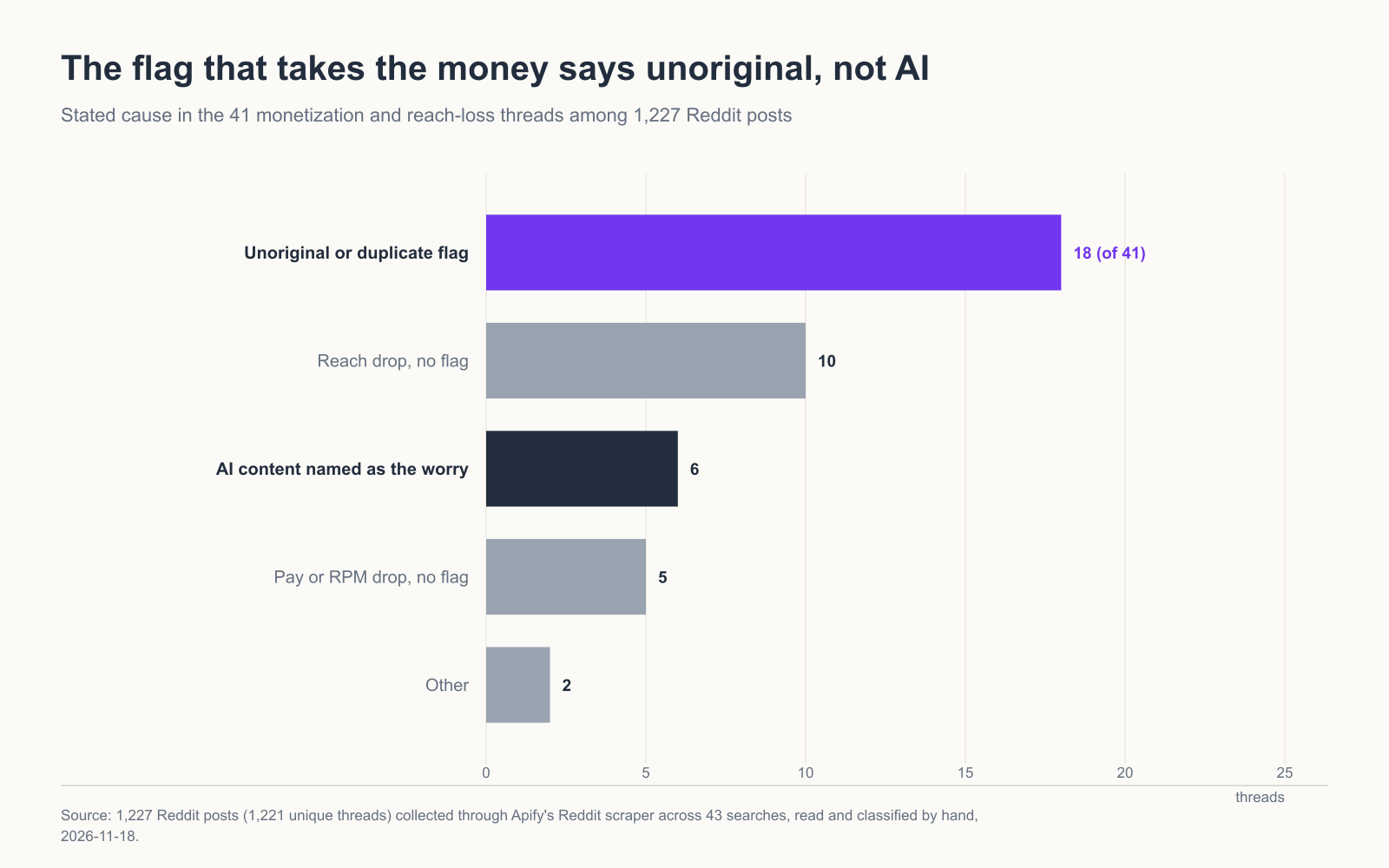
No. AI content does not get demonetized for being AI: in the 41 monetization and reach-loss threads inside the 1,227 Reddit posts we pulled, 18 are an unoriginal-content flag and 6 name AI as the worry. YouTube, TikTok and Instagram all allow AI tools, and all three cut pay or reach for the same thing: templated, mass-produced or copied output.
YouTube calls it inauthentic content and pulls the whole channel out of the Partner Program. TikTok pays only on qualified views of original videos over a minute. Instagram drops accounts that mostly repost out of recommendations.
Key findings
- In 41 Reddit threads about lost pay or reach, 18 are an unoriginal or duplicate flag, 10 a reach drop with no flag, 6 name AI content, 5 a pay drop with no flag, 2 other.
- TikTok Creator Rewards needs 10,000 followers, 100,000 views in 30 days, age 18, a personal account, videos of at least 60 seconds and a $50 payout threshold.
- YouTube’s January 2026 wave removed 16 channels with 35 million subscribers, 4.7 billion views and an estimated $10 million a year.
- Instagram’s AI-generated profile label, renamed August 31, 2026, costs no reach when switched on, and the April 30, 2026 originality rule removes aggregator accounts from recommendations on a rolling 30-day basis.
- One TikTok video reached 2.7 million views, about 1 million qualified, and paid $1.73, against $400 to $800 at the creator’s past RPM of $0.40 to $0.80.
- 34 of the 41 threads are about TikTok, 5 YouTube, 1 Instagram, 1 Facebook, and 21 sit in r/TikTokMonetizing alone.
Does AI content get demonetized?
AI content is demonetized when it reads as templated or mass-produced, not because a model made it. YouTube’s inauthentic content policy, TikTok’s originality rules and Instagram’s aggregator rule all target repetition and copying. In 41 Reddit threads about lost pay or reach, 18 are an unoriginal flag and only 6 blame AI.
We read all 1,221 unique threads and kept the 41 where a creator reports a lost payout, a flag, a disqualification, an RPM question or a collapse in views. The stated cause splits five ways: 18 an unoriginal or duplicate flag, 10 a reach drop with no flag, 6 AI content named as the worry, 5 a pay drop with no flag, 2 other.
Figure 1. Stated cause across the 41 monetization and reach-loss threads in 1,227 Reddit posts, read 2026-11-18.
The 6 AI threads ask this post’s question. A creator planning faceless language-learning videos with an ElevenLabs voice asks “Is AI content monetizable?”. Another was permanently disqualified for AI podcast videos under “Low-Quality Content,” TikTok’s name for the output, not the tool. The 18 unoriginal flags are the bigger story, and most hit videos the creator filmed.
What is YouTube’s inauthentic content policy?
YouTube’s inauthentic content policy is the YouTube Partner Program rule that bars monetization for repetitive or mass-produced videos, whether made by hand or with AI. It was renamed from repetitious content on July 15, 2025, split into three named categories on July 13, 2026, and it removes the whole channel from monetization rather than one video.
The policy page names what fails: “AI-generated content made with generic or unoriginal templates giving the impression of mass production,” and “image slideshows, templated storylines, or scrolling text with minimal or no narrative.” The allowed example is “using AI to visualize a unique character and narrative you invented.” A violation means monetization “suspended or permanently disabled on all or any of your accounts.”
On July 13, 2026 YouTube rewrote the policy into three categories, and Tubefilter carried the platform’s framing: “a communications fix: clearer, more actionable language,” with “the rules themselves haven’t changed.” The buckets are generic or repetitive content, unsatisfying or off-putting content, and AI personas giving “advice to viewers on topics such as health, legal issues, finances, or politics.”
The enforcement came first. In January 2026 YouTube removed 16 channels with 35 million subscribers and 4.7 billion lifetime views, an estimated $10 million a year, all from Kapwing’s November 2025 ranking of the 100 most-subscribed AI slop channels. Faceless creators with their own scripts went down with them.
The sleep-history niche shows the policy inside one format. On October 21 the operator behind @ytajourney got the email for Bedtime Republic, 140 videos and 2,300 subscribers: “Your channel is no longer eligible for monetization,” reason “repetitive content.” The same post reports The Snoozetorian, one of the largest faceless sleep channels, deleted, and Sleepless Historian “demonetized again.” A Dutch thread with 76 comments lists eleven faceless nostalgia channels sharing AI voice-overs and thumbnails. The template loses the channel.
Does TikTok pay for AI videos?
Yes, when the video is at least 60 seconds, carries the AI label, shows real editing and sits on a personal account. TikTok Creator Rewards pays on qualified views of original videos only. Photo Mode, Duets, Stitches, reposts, watermarked imports and AI people posted as-is without a label are outside the program, and one creator’s 2.7 million views paid $1.73.
The account bar is in the Creator Rewards Program terms: “at least 10,000 authentic followers,” “at least 100,000 authentic total video views in the last 30 days,” age 18, a personal account, videos of “at least 60 seconds,” and a $50 payout threshold. TikTok’s launch post puts originality first among four reward signals. Toptal’s guide lists the excluded formats, “Duets, Stitches, Photo Mode posts, and sponsored/paid promotional content,” defines a qualified view as 5 seconds or more from a real person, and puts creator-reported RPM at $0.40 to $1.00.
The AI rules sit in two other documents. The community guidelines require a label on “AI-generated or significantly edited content that shows realistic-looking scenes or people,” and unlabeled content gets “removed, restricted, or labeled by our team.” The originality policy puts content generated primarily through automated systems, without meaningful creator presence, outside monetization. The labeled AI character with a script, a cut and a voice track is paid, which is the shape of a face-of-brand character: a presenter the brand owns with a story arc of its own. The raw generator output is not paid. Slideshows are out on format alone, which is why the farms in our TikTok slideshows study sell products instead of collecting Creator Rewards.
Then comes the funnel. A creator with three years on the platform posted a video that hit 2.7 million views, with almost 1 million classed as qualified, and earned $1.73. Their RPM had sat between $0.40 and $0.80 for years, which puts 1 million qualified views at $400 to $800.
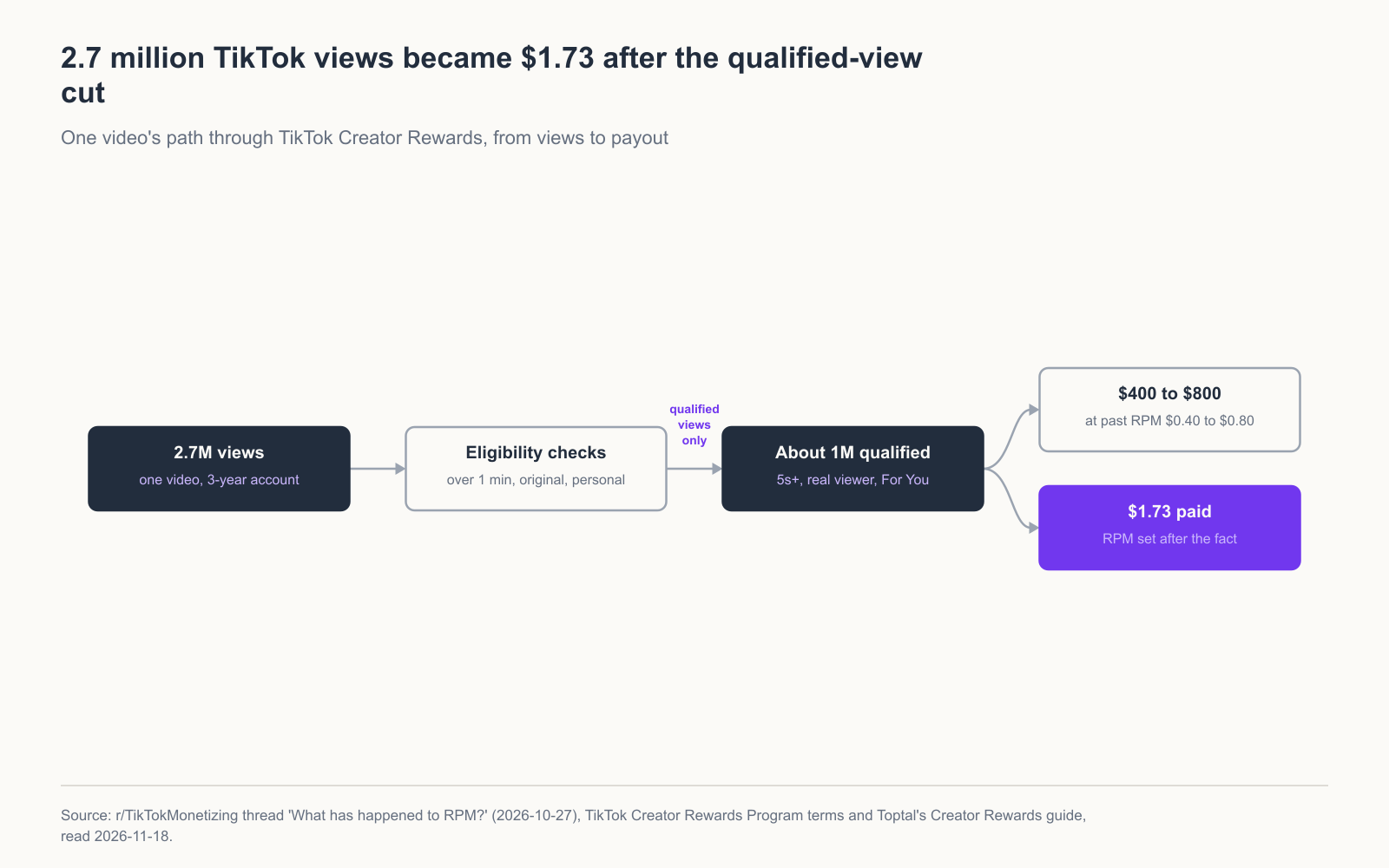
Figure 2. The views-to-payout funnel for one video from r/TikTokMonetizing, read 2026-11-18. Qualified views are the only ones that pay, and RPM is set after the fact.
Additional Rewards, the bonus layer, draws the rest of the complaints: one creator saw two stronger videos skip the bonus and earn $6 against an expected $80 to $120.
Why was my original video flagged as unoriginal on TikTok?
TikTok flags your original video as unoriginal because it matches footage, not authorship: the same file posted on YouTube first, re-uploaded after a delete, or reposted from your own older account reads as a copy. 18 of the 41 monetization threads we read are this flag, 34 of the 41 are about TikTok, and the appeals that win are the ones that keep pushing.
The clearest case is the creator whose appeal was rejected and who got TikTok staff on record after two weeks: the video “appears to have undergone only minimal editing or variation.” Asked whether posting on YouTube 30 minutes earlier was the cause, the agent confirmed it counts as unoriginal. Upload order is now a monetization decision. TikTok first, then everywhere else.
Delete-and-repost trips the same match. A creator who caught a typo in a concert video, deleted it and re-edited, never got the corrected version accepted after cropping, trimming and re-cutting. The operators in our multi-account study learned it from the other side: TikTok hashes media across accounts, so one clip on two accounts is a repost on both.
Appeals go three ways. The win is the creator who earned $1.3k in 10 days from 7 videos, had one video falsely disqualified, appealed by support ticket and got it overturned, with $400 carried into the next month. The loss is a creator permanently removed after $3,000 of boosted payouts in a month.
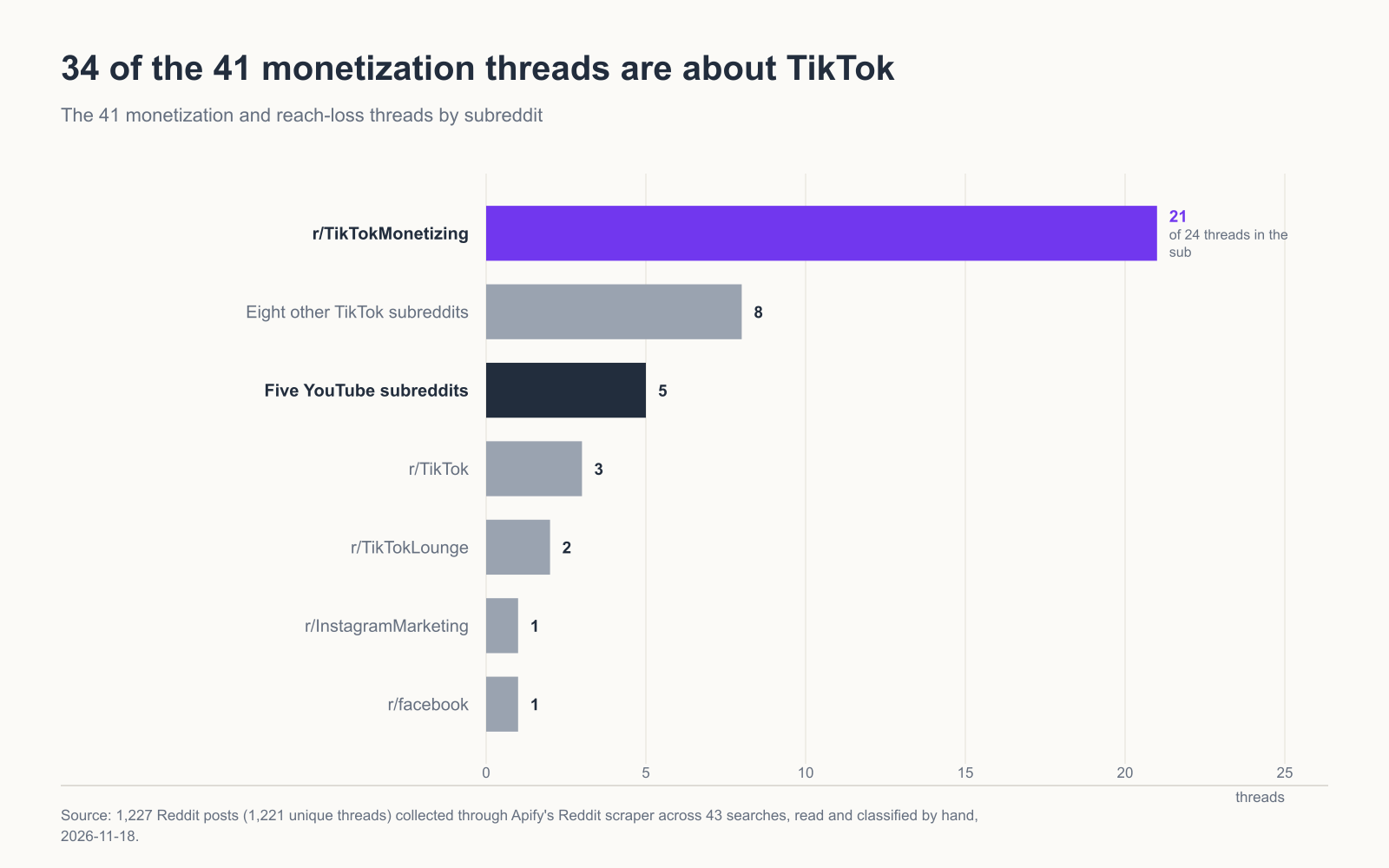
Figure 3. Where the 41 threads live. r/TikTokMonetizing has 24 threads in the corpus and 21 are about pay or reach.
The YouTube threads carry no flag: a channel that gained 50,000 views across 6 videos and then flatlined to under 10% of its earlier views, and one whose impressions fell from 5,000 to 10,000 per video to 15 to 20. YouTube’s only notice is the one that ends the Partner Program.
Does Instagram cut reach for AI content?
Instagram cuts reach for AI content only when the AI is undisclosed: since August 31, 2026 an account featuring an AI-generated person needs the AI-generated profile label, and Instagram states that accounts which add it keep their reach. The reach cut Instagram does apply is the April 30, 2026 originality rule, which drops accounts that mostly repost out of recommendations.
Instagram’s creator post of August 31, 2026 renamed the label from AI creator to AI-generated profile and drew the line: it is for profiles “featuring an AI-generated person,” not for creators who use AI tools. “Creators who proactively add the AI-generated profile label will not see a change to their profile’s reach.” Accounts that skip it see reach reduced. The per-post label is a different object. Meta’s AI info label, renamed from Made with AI on July 1, 2024, fires on AI indicators in the file or on self-disclosure, and labeled content stays up. It fires on humans too: Pierce Brosnan’s post got the AI label this week.
The rule that moves reach is originality. On April 30, 2026 Instagram told TechCrunch that accounts which regularly repost content they did not create “will no longer be eligible for recommendations across the app.” The test, per Social Media Today: “If most of what an account posts within that 30-day period are re-posts, it will be considered an aggregator account.” Reels were already covered, and photos and carousels now are. Low-effort edits do not count: “adding watermarks or changing the speed of a video,” or a screenshot with the username showing. Followers still see everything, recommendations stop, and Instagram’s originality page adds that visible watermarks fail on their own.
An AI character with its own posts passes both tests, and with the profile label on it keeps its distribution. The labels do a second job: they are the signal AI answer engines read when deciding which account to cite as the real thing, the ground our AI search work covers. The corpus holds one Instagram reach complaint: an operator of more than 10 theme pages stuck at 240,000 followers for 8 months with no strikes. Theme pages are aggregators by construction. April 30 explains the ceiling.
What stays paid: a decision table by content type and platform
| Content type | YouTube Partner Program | TikTok Creator Rewards | Instagram recommendations |
|---|---|---|---|
| AI character, your own script and story arc | Paid. Named as allowed | Paid if labeled, over 1 minute, edited | Recommended with the profile label on |
| Templated AI narration, near-identical videos | Not paid. Generic or repetitive | Not paid. Minimal creator presence | Recommended. The rule is about reposts |
| AI persona giving health or finance advice as a human | Not paid. Sensitive-topic persona | Label required, else restricted | Label required, else reach cut |
| Photo slideshow or carousel | Not paid with minimal narrative | Not paid. Photo Mode is excluded | Recommended when the images are yours |
| Reposted clips, watermark showing | Not paid | Not paid, flagged unoriginal | Not recommended |
| Your own video, posted on YouTube first | Paid | Flag risk, per TikTok support | Recommended |
| Duets and Stitches | n/a | Not paid | n/a |
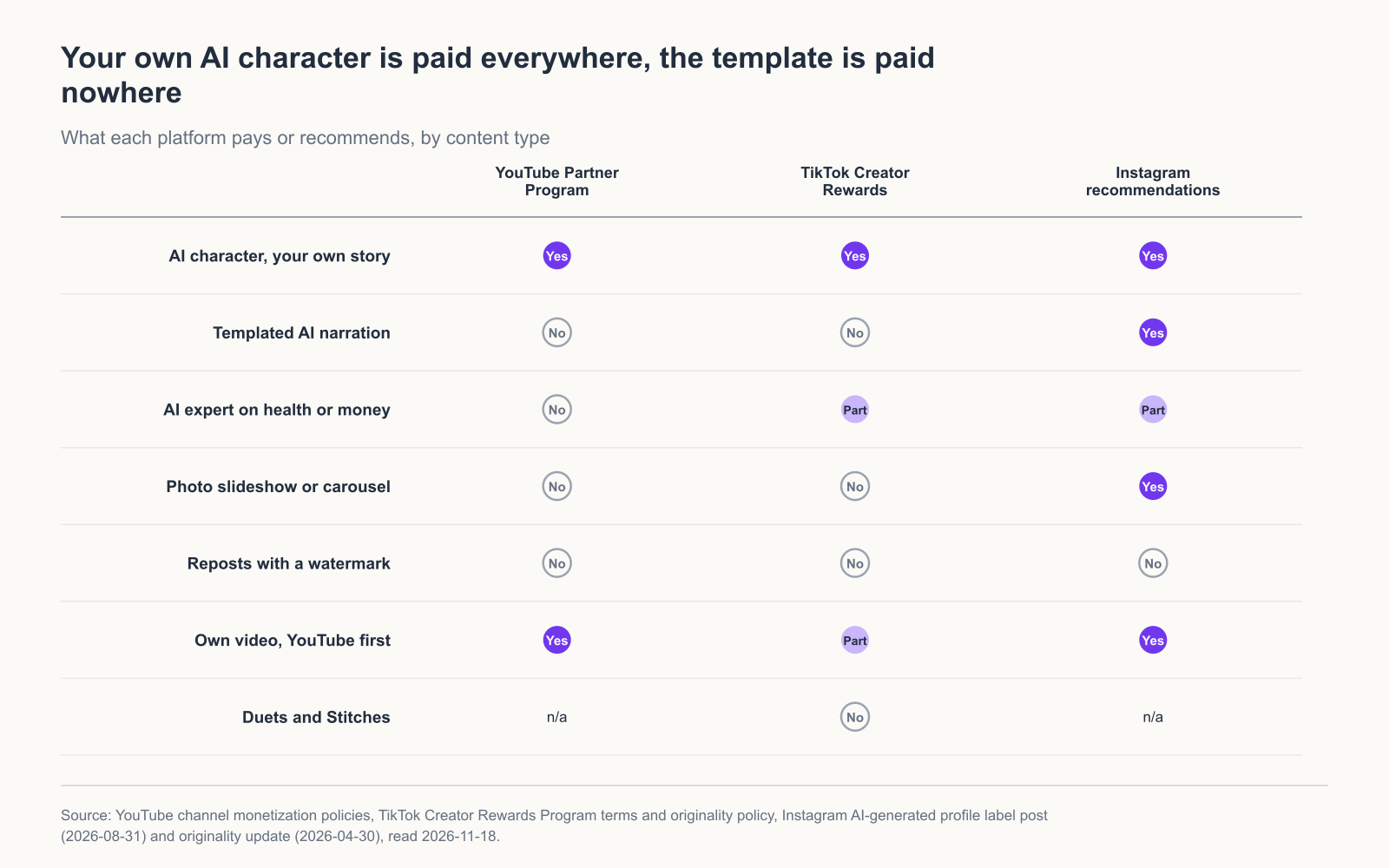
Figure 4. The table as a grid. Yes is paid or recommended, No is cut, Part turns on the label or the upload order.
Three decisions fall out of the table. Pick the platform by format: a scripted AI character belongs on all three, a slideshow on Instagram or selling off-platform, a reposted clip nowhere you want paid. Label every AI person on TikTok and Instagram, because the label costs nothing and its absence costs reach. Post to TikTok first and never re-upload a file TikTok has hashed. What a channel spends before any payout is in our content farm economics post.
Hi Violet keeps client accounts on the paid side of every one of these lines: a presenter and story arc the policy pages name as allowed, formats chosen per platform in our social media programs, AI labels on before the first post, and a posting order that keeps TikTok’s originality match clean. The same labels let AI search surface the account as the original, the job of our AI search service. If your faceless or AI-fronted channel has been flagged, or you want it built so it never is, request a strategy call.
How we did it
We pulled 480 X posts from 2026-09-01 to 2026-11-18 across eight searches through Apify’s tweet scraper by apidojo, and 1,227 Reddit posts from the last 30 days across 43 searches through Apify’s Reddit scraper by harshmaur, 1,221 of them unique threads. We read every thread and kept the 41 where a creator reports a lost payout, an unoriginal flag, a disqualification, an RPM question or a collapse in views, then counted them by subreddit, platform and stated cause. On 2026-11-18 we read YouTube’s monetization policies, TikTok’s Creator Rewards terms, community guidelines and originality policy, Instagram’s label post and originality page, Meta’s AI label announcement, Kapwing’s AI slop report, and the trade coverage linked above.
FAQ
Does AI content get demonetized?
Not for being AI. YouTube, TikTok and Instagram all allow AI tools and all three cut pay or reach for templated, mass-produced or copied output. In 41 Reddit threads about lost pay or reach, 18 were an unoriginal-content flag and 6 named AI.
What is YouTube’s inauthentic content policy?
The YouTube Partner Program rule that bars monetization for repetitive or mass-produced videos. Renamed from repetitious content on July 15, 2025, and split into three named categories on July 13, 2026. In January 2026 it took down 16 channels with 4.7 billion views.
Does TikTok pay for AI videos?
Yes, when the video is at least 60 seconds, carries the AI label, shows real creator work and sits on a personal account with 10,000 followers and 100,000 views in 30 days. Photo Mode, Duets, Stitches, reposts and unlabeled AI people earn nothing.
Why was my original video flagged as unoriginal on TikTok?
TikTok matches footage, not authorship. Posting the same file on YouTube 30 minutes earlier, re-uploading after a delete, or reposting your own old clips all trip the flag. 18 of 41 monetization threads we read were this flag, and one appeal won back $400.
Does Instagram cut reach for AI content?
Only when it is undisclosed. Since August 31, 2026 an account featuring an AI-generated person needs the AI-generated profile label, and labeled accounts keep full reach. Since April 30, 2026 accounts that mostly repost lose recommendations entirely.
Does YouTube demonetize faceless AI channels?
Yes when the channel is templated. The inauthentic content policy names image slideshows, templated storylines and AI content made with generic templates. In January 2026 YouTube removed 16 channels with 4.7 billion views, and a 140-video sleep-history channel lost monetization in November.
How many views do you need for TikTok Creator Rewards?
100,000 authentic video views in the 30 days before you apply, plus 10,000 authentic followers, age 18 and a personal account. After that, only qualified views on videos over 1 minute pay, and the payout threshold is $50.