Should Your Product Have an MCP Server? How AI Agents Choose Tools
An MCP server for SaaS is now table stakes: 25 of 30 developer products publish one. What wins the agent's pick is the path it can finish without an account.
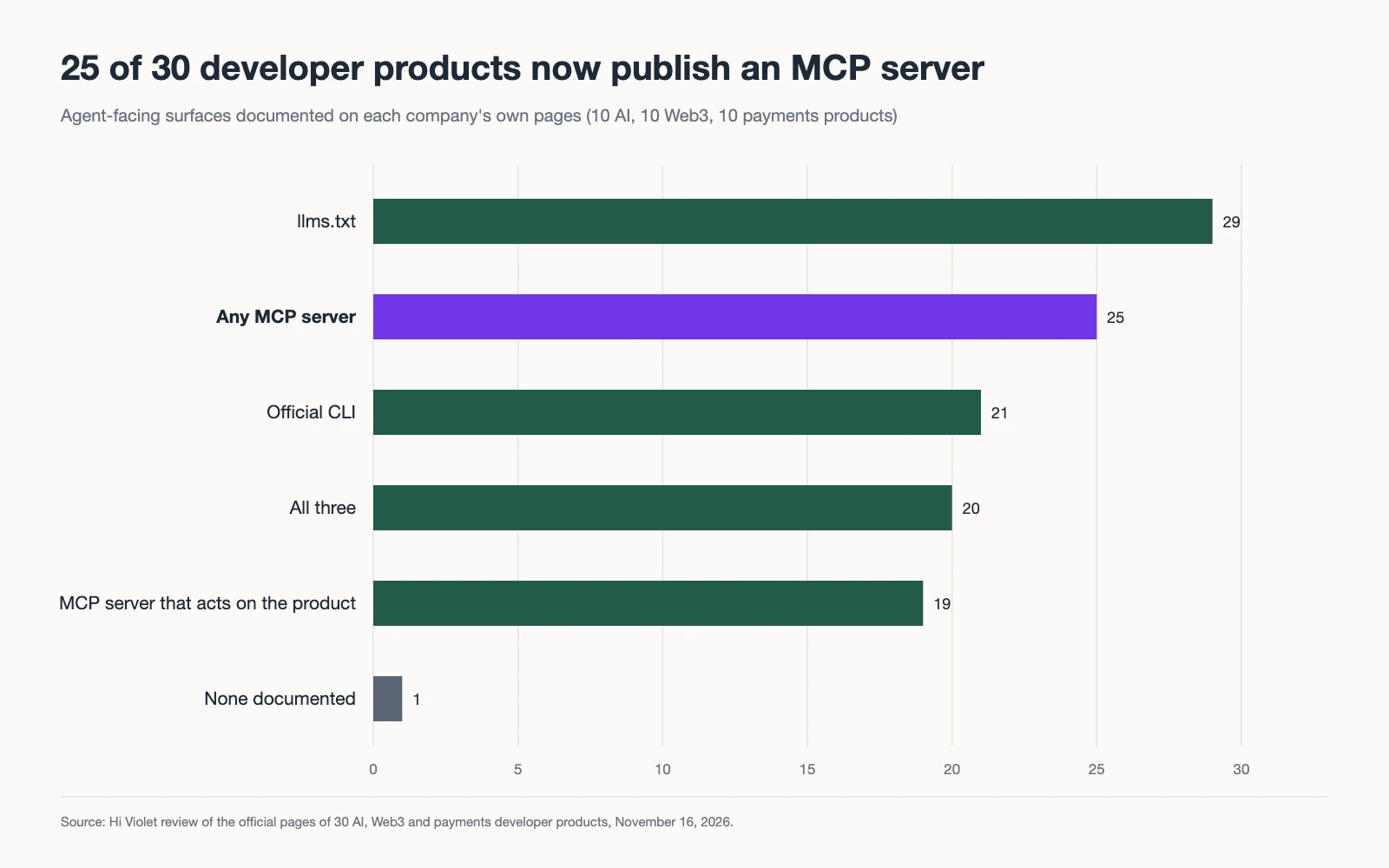
An MCP server for SaaS is no longer a differentiator. The Hi Violet AX Panel 2026 read the official pages of 30 developer products across AI, Web3 and payments on November 16, 2026: 25 publish an MCP server, 29 publish an llms.txt file, and 20 ship an MCP server, a CLI and llms.txt together. Every serious developer product now has a way in for agents. The question that decides who gets picked has moved. It’s whether the agent can finish the job without stopping for an account.
We watched that decision happen. Given an open build task that named no vendor, Claude Code and OpenAI Codex picked the same protocol in six runs out of six, then split on the provider by one criterion: which one let them start without merchant credentials.
What is an MCP server, and does your product need one?
An MCP server is an endpoint that exposes your product to AI agents through the Model Context Protocol: a set of tools an agent can call to search docs, create resources or act on a user’s account. Your product needs one if you want agents to use it, not only read about it. Most developer products already have one.
At a glance
- 25 of 30 developer products publish an official MCP server. 19 of those let an agent act on the product; 6 only search documentation or help write code.
- 29 of 30 publish llms.txt. 21 of 30 ship an official CLI. 20 of 30 have all three.
- Payments leads on product MCP servers: 8 of 10 payments products publish one that acts on the account.
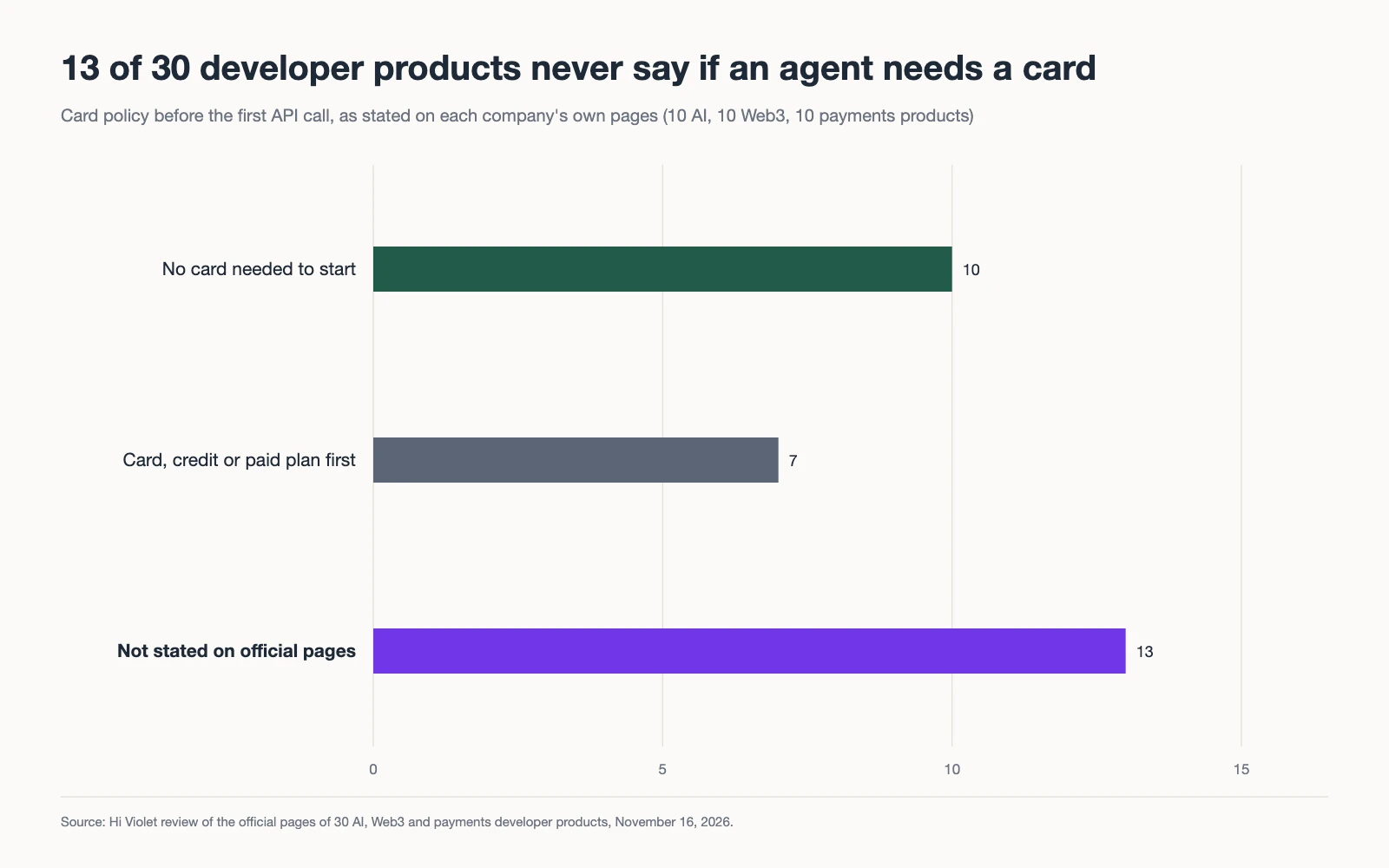
- In Hi Violet’s tool-choice runs, both agents chose x402 to charge agents per request, every time, and both passed on Stripe’s machine payments because it needs a Stripe merchant account first.
- Codex picked PayAI’s x402 facilitator in all three of its runs over Coinbase’s, the protocol’s originator. PayAI needs no signup or API key to start. Coinbase’s facilitator needs a CDP API key.
- What wins the pick: the fewest accounts between the task and working code.
How many developer products publish an MCP server?
Twenty-five of the 30. Hi Violet checked each company’s own pages, and only those, for an official MCP server, an official CLI and an llms.txt file. The panel is 10 AI developer platforms, 10 Web3 infrastructure products and 10 payments products, all self-serve.
| Agent surface | AI (10) | Web3 (10) | Payments (10) | All 30 |
|---|---|---|---|---|
| llms.txt | 10 | 10 | 9 | 29 |
| Any official MCP server | 8 | 8 | 9 | 25 |
| MCP server that acts on the product | 5 | 6 | 8 | 19 |
| Official CLI | 8 | 8 | 5 | 21 |
| All three | 7 | 8 | 5 | 20 |
Figure 1. Agent surfaces documented on each company’s own official pages, read on November 16, 2026. “Acts on the product” excludes MCP servers that only search documentation or generate code. Source: Hi Violet’s 30-product agent experience panel.
The five without an MCP server are Groq, Modal, Infura, Moralis and Lemon Squeezy. Even there, four of the five publish llms.txt. Lemon Squeezy is the only product whose official pages document none of the three.
The split between documentation servers and product servers matters more than the headline count. Together AI, Fireworks AI and Cohere run MCP servers that search their docs. Privy and Dynamic do the same. Circle’s MCP server helps an agent generate and fix code against Circle’s products. Those help an agent learn. Stripe, PayPal, Square, Alchemy, QuickNode and Mistral run servers that let the agent act on the account. Those help an agent work.
How do AI agents choose which tool to use?
They choose what they can verify and run without help, which starts with answers they can find on your own pages. Microsoft’s developer advocates split agent experience into two measures: propensity, “does the agent find your technology and choose it?”, and efficacy, “once the agent uses your technology, does it use it correctly?” An MCP server mostly serves efficacy. The pick happens earlier.
To measure propensity, Hi Violet gives coding agents open build tasks that never name a vendor, in an empty project folder, and records three things: the vendor the agent picks, the reason it gives, and every step where a human would have to step in. The agents are Claude Code and OpenAI Codex. Each task runs three times per agent. Every session keeps its full transcript.
One task: build “a minimal Node.js + TypeScript project that charges AI agents per API request without requiring them to create an account.” Here is what came back.
| Run | Protocol | Provider picked | Considered and passed on |
|---|---|---|---|
| Claude Code, run 1 | x402 | Coinbase CDP facilitator (x402.org on testnet) | Stripe machine payments, L402, Skyfire, Nevermined, Payman, usage billing |
| Claude Code, run 2 | x402 | Coinbase CDP facilitator (x402.org on testnet) | Stripe machine payments, L402, Nevermined, Skyfire |
| Claude Code, run 3 | x402 | Coinbase CDP facilitator (x402.org on testnet) | Stripe machine payments, Stripe metered billing, L402, Skyfire |
| Codex, run 1 | x402 | PayAI facilitator | Coinbase CDP facilitator, Stripe machine payments, x402.org |
| Codex, run 2 | x402 | PayAI facilitator | Stripe machine payments, x402.org, self-hosted facilitator, 0xGasless |
| Codex, run 3 | x402 | PayAI facilitator | Coinbase CDP facilitator, Stripe machine payments, x402.org |
Figure 2. Vendor choice for one open build task, six sessions on November 16, 2026. Each agent wrote the server, a package.json and a README; neither installed packages or created accounts. Source: Hi Violet tool-choice runs.
Six out of six chose x402, the HTTP 402 payment protocol we cover in our guide to x402 payments for APIs. All six listed Stripe’s machine payments among the alternatives, and all six passed on it for the same reason: it needs a Stripe merchant account before the first paid request. One Claude Code run put it plainly: Stripe “needs a Stripe account and Stripe approval for stablecoin payments.”
One paid request over x402No account, no API key: the payment authorizes the request
Figure 3. The flow every run built: the agent pays inside the HTTP request, so no account sits between the caller and the API. Header names follow the x402 V2 specification.
Why did the agents pick the provider with the fewest accounts?
Because an account is a step they cannot finish. The agents read the docs, counted the human steps, and picked the path with fewer of them.
Codex is the clearest case. When it weighed Coinbase’s x402 facilitator, it wrote down the objection in plain terms: it “requires merchant API credentials,” and “merchant setup requires a CDP API key.” Coinbase’s docs confirm that the CDP facilitator authenticates with a CDP API key ID and secret. PayAI’s pricing page says the opposite: “No sign-up or API key needed,” with 1,000 free credits to start. Codex picked PayAI every time.
Claude Code made the same trade at a different step. It built against the keyless public facilitator at x402.org, which the x402 seller quickstart lists for testing on Base Sepolia and Solana devnet, so the project runs with no accounts at all. It moved the Coinbase account to the end, as a mainnet step for the human.
Price wasn’t the deciding factor in any run. Coinbase’s facilitator is free for the first 1,000 transactions a month and $0.001 each after that. PayAI starts with 1,000 free credits. Both start free. They differ on one thing: whether the agent can start without a key.
That is the lesson for any product competing for an agent’s pick. The agent reads your docs, finds the first step that needs a human, and compares it with the next vendor’s first human step. The vendor whose human steps come later wins.
Should your API have an MCP server?
Yes, if you want agents to act on your product, and build it after you fix the path into the product. Twenty-five of 30 developer products already ship one, so not having one is now the visible gap. But the runs show the MCP server isn’t where the pick is decided. The account is.
Three rules from the panel:
- Ship a product server, not only a docs server. A docs search server tells an agent how your API works. A product server lets it do the work. Nineteen of the 25 servers we found act on the product. Be one of those.
- Shrink the human step in front of the server to one click. Alchemy’s MCP server needs a single OAuth approval and no API key or local install. Tenderly’s needs a paid plan enabled through sales. Both are official MCP servers. One costs the developer a click; the other costs a sales call.
- Fix the docs before you build new tools. Microsoft found this on its own SharePoint Framework docs: “rather than shipping a skill, we fixed the release notes instead. After that, every run used the CLI without being told.” The cheapest efficacy gain is usually a page you already have.
What is an MCP Server Card, and should you publish one?
An MCP Server Card is a JSON file at /.well-known/mcp/server-card.json that describes your MCP server before an agent connects: the tools it exposes, how to reach it and how to authenticate. It’s a draft proposal. Cloudflare’s April 2026 scan of the top 200,000 domains found MCP Server Cards and API Catalogs on fewer than 15 sites in the whole dataset.
Publish one. It costs an afternoon, and it answers the question an agent asks before it connects: what do I need to get in? With 25 of 30 developer products running an MCP server and almost none advertising it this way, the card is one of the few agent surfaces where you can still be early.
What is agent-led growth, and why does the pick matter?
Agent-led growth is growth where an AI agent chooses, sets up and integrates a product for a person. The agent becomes the evaluator. Vercel reports that more than 50% of its deployments now start with a coding agent, up from over 30% in April 2026.
When the agent picks, the pick compounds. A developer who asks Codex to “charge agents per request” gets PayAI wired into the code, the README and the environment file. Changing that later is a migration, not a preference. The vendor that wins the first run keeps the account.
This also changes who your docs are for. The runs above cited docs pages, quickstarts, package manifests, GitHub examples and pricing pages. Almost every source was documentation, code or pricing. If the pricing terms that decide the pick sit only on a sales call, the agent counts that as a human step. Our method piece on testing agent readiness against task completion shows how to find those steps on your own product, and our account-creation guide covers how to remove them without inviting bots.
Which surfaces should you build first?
In order of what moves an agent’s pick:
| Order | Build | Why |
|---|---|---|
| 1 | An account path an agent can finish, or none at all | The pick turns on the first human step |
| 2 | Pricing and limits stated in your docs | Agents compare vendors from the page, not the sales call |
| 3 | A product MCP server with documented auth | 19 of 30 competitors already have one |
| 4 | A CLI with machine-readable output | 21 of 30 ship one; agents run them directly |
| 5 | llms.txt and an MCP Server Card | llms.txt is near universal; the card is still rare |
Payments products show where this goes. Eight of the 10 payments companies in the panel already run a product MCP server, and the fight for the agent’s pick has moved to which rail needs the fewest accounts. Our comparison of agent payment protocols covers how those rails differ and which to accept first.
How Hi Violet measures and wins the agent’s pick
Hi Violet runs your category’s open build tasks through Claude Code and Codex, several times each, and records which vendor the agents choose, why, and where they stop for a human. That gives you propensity: how often agents pick you, and the exact sentence they use when they don’t. Then we run the tasks that use your product, step by step, for efficacy.
The fixes follow from the transcripts: an account path agents can finish, pricing an agent can quote, a product MCP server with no human gate, payments over x402 or the PIVX Agent Kit where agents pay directly, and temporary access with qURL for agents evaluating on a buyer’s behalf. Disclosure: Hi Violet is affiliated with PIVX Labs. Then we rerun the same tasks and show you the new pick rate.
See how the agent experience program works, read how the runs work, or request access to have your category tested. The process matches what we describe in the growth signal stack: measure the decision itself, not the data that happens to be easy to collect.
Frequently asked questions
Should my API have an MCP server?
Yes, if you want agents to act on your product. Twenty-five of the 30 developer products Hi Violet checked already publish one, so leaving it out is now the gap. Build a product server, not just a documentation search server, document how it authenticates, and fix the signup and docs it depends on first. An MCP server cannot help an agent that never gets an account.
How do AI agents choose which tool or vendor to use?
They pick what they can verify and run with the fewest human steps. In Hi Violet’s tool-choice runs, Claude Code and Codex read docs, quickstarts and pricing pages, compared the first step each vendor needed from a human, and picked the vendor whose human steps came last. Both named account requirements as the reason they passed on alternatives.
What is the difference between a docs MCP server and a product MCP server?
A docs MCP server lets an agent search your documentation. A product MCP server lets it act on the user’s account: create resources, read data, run payments. Of the 25 MCP servers in Hi Violet’s panel, 19 act on the product and 6 only search documentation or help write code.
What is an MCP Server Card?
An MCP Server Card is a JSON file at /.well-known/mcp/server-card.json that tells an agent what your MCP server does, where it lives and how to authenticate before it connects. Cloudflare found MCP Server Cards and API Catalogs on fewer than 15 of the top 200,000 domains in April 2026.
What is agent-led growth?
Agent-led growth is growth where AI agents choose, set up and integrate your product on a person’s behalf. More than half of Vercel’s deployments now start with a coding agent. When the agent picks the vendor, the vendor it picks ends up in the code, the README and the environment file, and keeps the account.
Is llms.txt enough to make a product agent ready?
No. Twenty-nine of the 30 products Hi Violet checked publish llms.txt, so it no longer sets a product apart. It helps agents find and read your docs. The pick is decided later, at the account, key and payment steps the agent has to clear.