How Do AI Agents Sign Up? 30 Developer Products Tested
How do AI agents sign up? Hi Violet checked 30 AI, Web3 and payments products: who gives agents keys, who wants a card first, and who skips signup entirely.
How do AI agents sign up for the software they’re asked to build with? Through doors built for people. In the Hi Violet AX Panel 2026, we checked 30 developer products across AI, Web3 and payments. 29 of them let a developer get test or development keys without a sales call. 25 publish an MCP server. 29 publish an llms.txt file. Only one, Stripe, documents a signup path built for coding agents: working test keys from one CLI command, with no account and no human until claim time. Everywhere else, the agent reaches a web form, an email code, a card field or a sales calendar, and hands the job back to a person.
That handoff is the most expensive moment in agent onboarding. The agent has already picked your product. It has read the docs. It knows the first call it wants to make. Then signup stops it, and the developer it works for has to open a browser and finish what the agent started, or pick a product the agent can finish on its own.
How do AI agents sign up for software?
AI agents sign up for software by following the same path a developer would: a web registration form, a CLI login, or an OAuth flow. Each path ends at a human step such as a CAPTCHA, an email code, a card form or a sales call. A small number of products give agents credentials directly, without an account.
At a glance
- Self-serve keys are nearly universal. 29 of 30 products publish a self-serve path to test or development credentials. Tenderly is the exception: its API needs a paid plan arranged through sales.
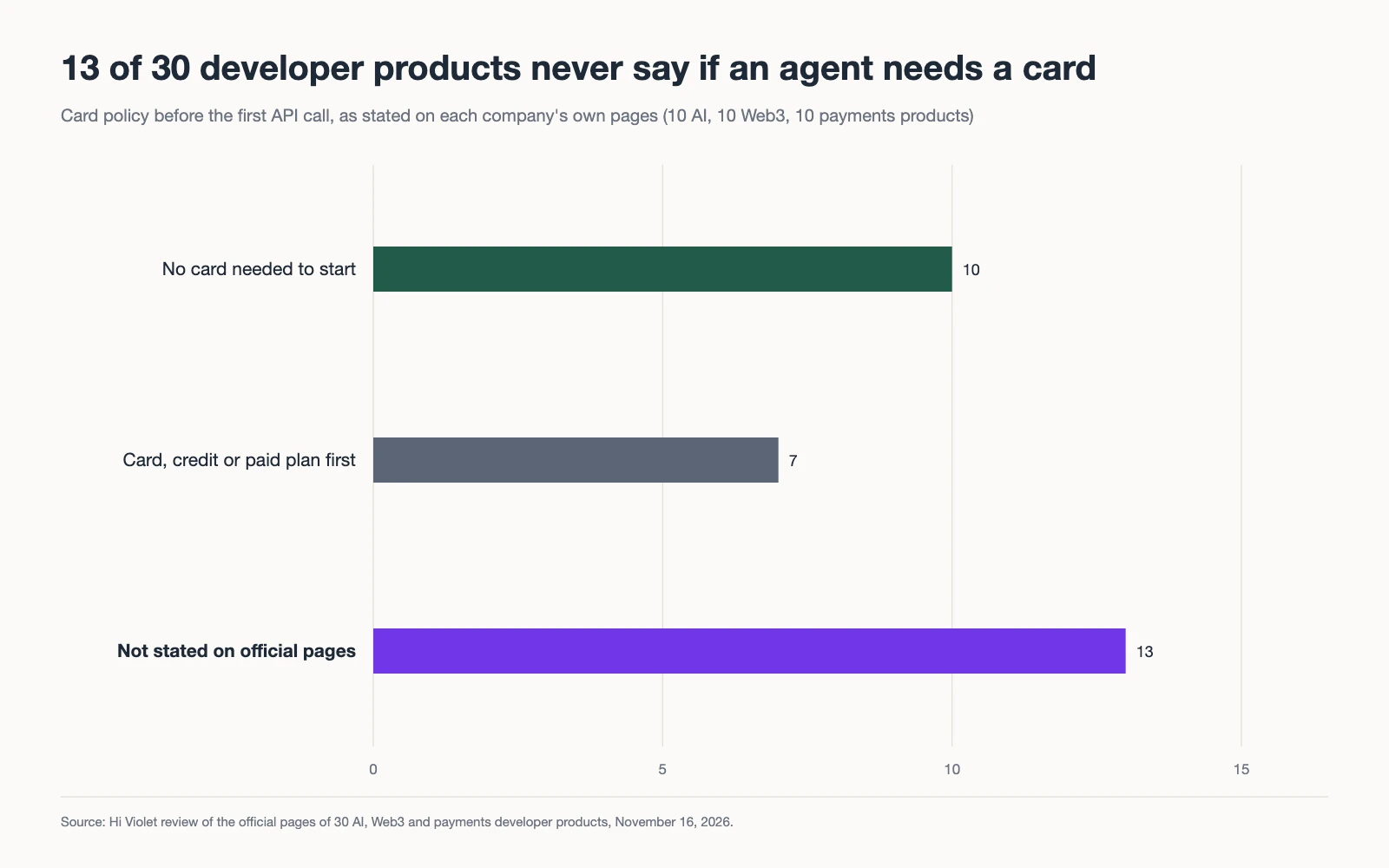
- Card policy is split, and often unstated. 10 products say no card is needed to start. 7 require a card, prepaid credit or a paid plan for at least part of the API. 13 don’t say either way.
- Payments and Web3 products document test environments; AI APIs don’t. All 10 payments products and all 10 Web3 products describe a sandbox, test mode or testnet. One of 10 AI APIs does.
- Agent tooling is everywhere. 29 products publish llms.txt, 25 publish an MCP server, 21 publish a CLI, and 20 publish all three.
- Stripe is the clearest agent path.
stripe sandbox createprovisions working test keys without an account, verified by proof of work instead of a CAPTCHA. All six of our agent runs found it.
What did Hi Violet test?
Hi Violet ran Claude Code and OpenAI Codex against 30 developer products in sandboxed sessions, in November 2026. The panel covers three markets: 10 AI developer platforms, 10 Web3 infrastructure products and 10 payments products. We left out products made by OpenAI and Anthropic, so neither agent was asked about its own maker.
| Segment | Products |
|---|---|
| AI | Mistral AI, Groq, Together AI, Fireworks AI, Replicate, Hugging Face, ElevenLabs, Pinecone, Cohere, Modal |
| Web3 | Alchemy, Infura, QuickNode, Helius, Moralis, thirdweb, Privy, Dynamic, The Graph, Tenderly |
| Payments | Stripe, PayPal, Square, Adyen, Paddle, Lemon Squeezy, Mollie, Checkout.com, Coinbase Developer Platform, Circle |
Every fact in this article comes from the company’s own pages. For each product, a separate session could fetch only that company’s official domains, and it had to return the URL and a verbatim quote for every answer. When the official pages didn’t answer a question, we recorded that as “not stated.” That’s a finding in itself: an agent can’t act on a policy the company never writes down.
For Stripe, we also sent both agents through the full signup task three times each: find signup, read the requirements, get credentials, and make a first call, without submitting a form or creating anything. The run boards behind this work use the same marks as our agent experience audits: Cleared, Asked, Stopped. The protocol is the one described in agent readiness score vs. task completion.
Can an agent get API keys without talking to sales?
Yes, for test and development keys at 29 of 30 products. The usual pattern is a dashboard signup followed by a “create key” button. ElevenLabs, Pinecone, Groq, Alchemy, Privy, Circle and others all document it in a few lines.
The exception is Tenderly: “Generating API access tokens and using the Tenderly API are available on the paid plan. To enable them for your account, contact our sales team to schedule a call.” Its free plan works in the browser, with no API.
Two payments companies split test from live. Adyen lets you create a free test account yourself, but a live account needs Sales, approval and a contract. Checkout.com offers a self-serve test account and doesn’t describe self-serve live signup. For an agent building a prototype, that split is fine. Test keys are what it needs.
“Self-serve” still means a person at a browser, though. Every one of those 29 dashboard paths starts with a registration form, a Google or GitHub login, or a wallet connection that a human approves. Self-serve removes the salesperson. It doesn’t remove the human.
Does an agent need a credit card before its first API call?
Often, and the answer is frequently missing. Here’s how the 30 official sites answer the question.
| Card policy before the first API call | AI | Web3 | Payments | Total |
|---|---|---|---|---|
| No card needed to start | 5 | 4 | 1 | 10 |
| Card, prepaid credit or paid plan required (for at least part of the API) | 4 | 2 | 1 | 7 |
| Not stated on official pages | 1 | 4 | 8 | 13 |
Figure 1. Card policy before the first API call, from each company’s own pages, November 2026. “Required” includes products that require payment only for part of the API: Modal for GPUs, Coinbase Developer Platform for its Node API, and thirdweb for mainnet.
The products that say “no card” say it plainly. Helius: “Get started in less than 10 seconds. No credit cards or email required.” ElevenLabs, Cohere, Alchemy, QuickNode, Fireworks, Replicate, The Graph, Pinecone’s trial and Lemon Squeezy all publish a version of the same promise.
The products that require payment say that plainly too. Together AI: “To use the platform, you must purchase at least $15 of credits.” Mistral: “Creating API keys and using the API require billing activation and pay-as-you-go.” Hugging Face’s Inference Providers give free users no monthly credits, so they buy credits first.
A card requirement is a hard stop for an agent. It can’t hold a card, and it shouldn’t. Some products already route around this for agents with stablecoin payment rails like x402, where the payment itself authorizes the request.
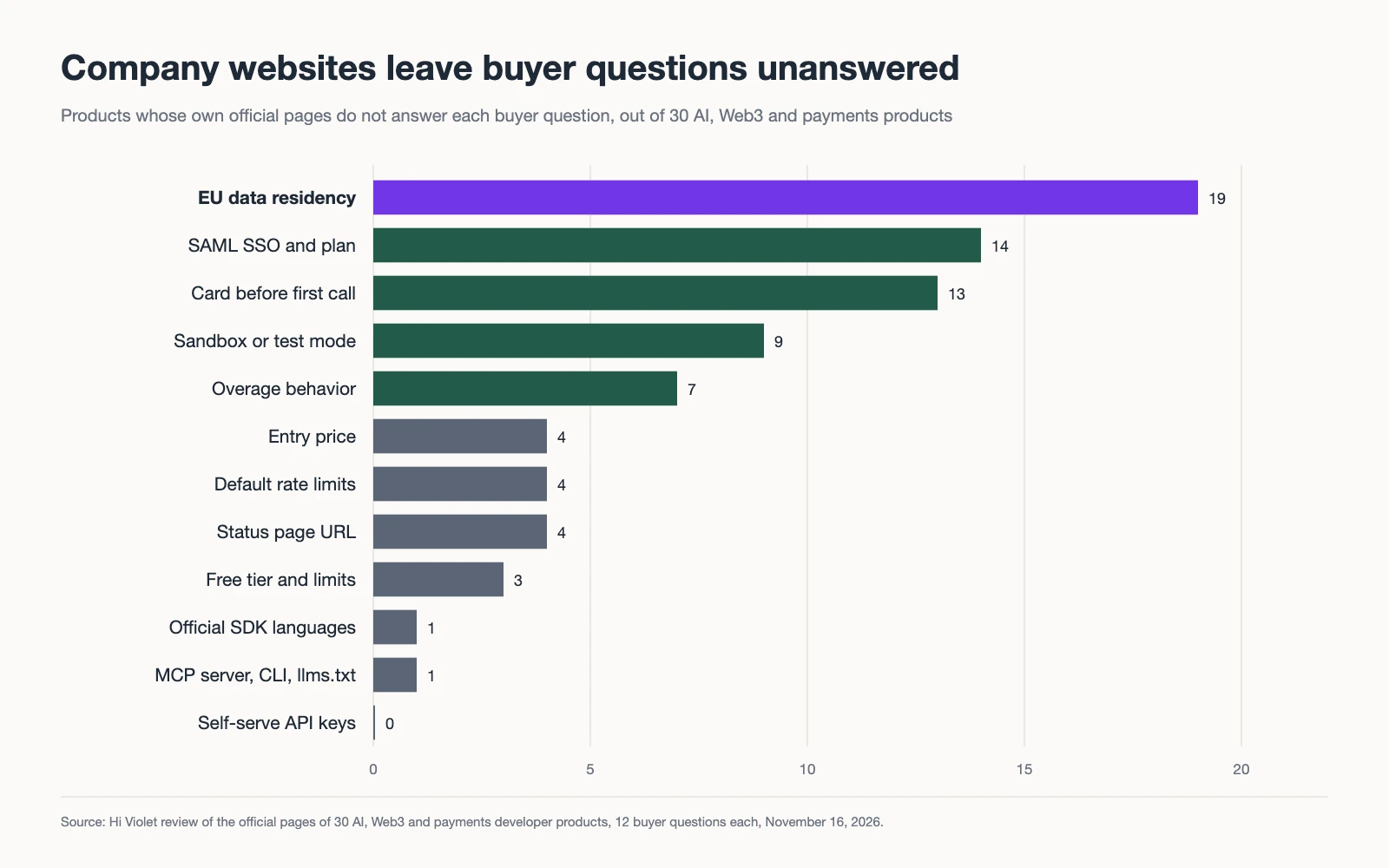
The 13 silent products matter most. Payments companies lead the silence: 8 of 10 never say whether a developer needs a card before the first test call, because their test modes don’t charge anything. A human developer shrugs and signs up. An agent asked “can I try this without a card?” has nothing to quote, so it guesses or asks.
Which products give agents a test environment?
21 of 30. Every payments product and every Web3 product documents one: Stripe sandboxes, the PayPal sandbox, Square’s free sandbox with unlimited calls, Lemon Squeezy’s test mode, testnets at Alchemy, QuickNode and thirdweb, Dynamic’s free Sandbox environment. Of the 10 AI APIs, only Modal describes separate environments, and it doesn’t call them a test mode.
AI APIs rely on free tiers and starter credit instead. That works when the tier exists. When it doesn’t (Together AI, Mistral’s API, Hugging Face’s Inference Providers for free users), an agent has nowhere to make a first call without someone paying.
A test environment is the safest place to give an agent keys. Nothing it does moves real money or touches production data. Products that already have one are a short step from letting agents into it directly.
How did Stripe make signup agent-completable?
Stripe moved the human step to the end. Its CLI command stripe sandbox create “provisions a new sandbox with working test API keys, without requiring an account. This enables you, a coding agent, or an automated workflow to start building a Stripe integration immediately.”
Three design choices make it work:
- Proof of work instead of a CAPTCHA. The CLI “uses a proof-of-work challenge to verify the request.” Stripe’s engineering blog explains that the CLI gets a salt and a challenge and brute-forces the answer, which works in a terminal where a CAPTCHA can’t.
- An expiry. “Sandbox environments expire after 7 days.” Unclaimed test data gets deleted.
- A claim step for the human.
stripe sandbox claimopens a claim URL in a browser. The claimed sandbox keeps every object the agent created.
All six of our agent runs found this path. Claude Code and Codex, three runs each, marked Stripe’s signup as completable by an agent for test credentials, cited Stripe’s own documentation, and identified the claim as the first step that needs a person. They also read the HTML of Stripe’s web registration page and found hCaptcha enabled on it. That’s the contrast in one product: the browser door has a CAPTCHA, and the agent door has a proof-of-work check.
This is the pattern we describe in how to let AI agents create accounts: give the agent a capped, expiring account now, and let a human claim it later.
A gated free signup with a claim linkThe agent gets a capped account now; a human takes ownership later
Figure 2. The claim-later signup. The agent requests an account, the product verifies the request and issues capped test credentials with a claim URL, the agent builds, and a human claims the account to keep it. Stripe’s claimable sandboxes follow this shape, with proof of work as the check and seven days as the cap.
Where do AI agents still get stopped at signup?
At five kinds of gate. Our agent runs and the 30 official sites show the same set:
| Gate | Where it appears | Why it stops an agent |
|---|---|---|
| CAPTCHA | Web registration forms (Stripe’s web form loads hCaptcha) | Built to stop software |
| Email or SMS code | Most dashboard signups (Mollie’s go-live checklist puts email verification before the test key) | The agent can’t read the developer’s inbox |
| Card or prepaid credit | Together AI, Mistral, Hugging Face Inference Providers | The agent shouldn’t hold payment details |
| Sales call | Tenderly API access, Adyen live accounts | Calendar, not software |
| Browser login | CLI logins and claim flows that open a browser | Needs a person at the screen |
Every one of these gates exists for a good reason. Fraud, abuse and compliance are real. The fix isn’t to remove them. It’s to give a verified agent a capped path around them, then put the gate where a human is already present: at claim time, at upgrade time, at go-live.
Do MCP servers and llms.txt solve agent signup?
No. They solve what comes after signup, and they shape which tool an agent picks in the first place. The panel is far ahead on agent tooling:
| Agent surface | AI | Web3 | Payments | Total |
|---|---|---|---|---|
| llms.txt | 10 | 10 | 9 | 29 |
| Official MCP server | 8 | 8 | 9 | 25 |
| Official CLI | 8 | 8 | 5 | 21 |
| All three | 7 | 8 | 5 | 20 |
Figure 3. Agent surfaces the 30 products document on their own sites, November 2026. Docs-only MCP servers count as MCP servers.
An MCP server gives an agent tools. Most of those tools need credentials that a human created first. Checkout.com’s MCP server needs an active Dashboard account. Tenderly’s is a paid-plan feature enabled through sales. The agent surface sits behind the human door.
That’s the gap. Teams have done the visible agent work (llms.txt, an MCP server, a CLI) and left the first step, getting keys, built for a browser. An agent can read every page of your docs and still not make a first call.
What should you change so AI agents can sign up?
Start with the steps an agent hits first, in this order:
- Write down your card policy. If no card is needed for test keys, say so on the pricing page and in the quickstart, in one sentence an agent can quote.
- Give agents a test environment they can reach. Payments and Web3 products already have one. AI APIs can ship a capped, test-only key with a small starter credit.
- Add an agent signup path that ends in a claim. Issue capped, expiring credentials to a verified agent request, and let a human claim the account. Stripe’s claimable sandboxes are the reference design. Signed agent requests and auth.md are the identity options.
- Put the human gate at claim and go-live. Keep CAPTCHAs, email checks and KYC where they protect real money and real data.
- Expose the agent path in llms.txt and your MCP server docs. Agents find what you point them to.
- Re-run agents through signup after every change. A path that worked in March can break in May.
For one-off evaluations of private products, a temporary access link can replace signup entirely.
How Hi Violet tests agent signup
Hi Violet sends coding agents, browser agents and assistants through your signup in sandboxed sessions, many times each, and marks every step Cleared, Asked or Stopped. We check every requirement against your own pages, find the first gate that needs a human, and build the agent path around it: a claimable sandbox, a signed-agent signup, payment over x402 or the PIVX Agent Kit where the buyer is an agent, or a qURL for temporary access. Then we run the same agents through the same task again, to show the gate is gone.
See how an agent experience audit works, read how the runs work, or request access to put your signup through it.
Frequently asked questions
How do AI agents sign up for software?
Mostly through the doors built for humans: a web form, a CLI login or an OAuth flow. Each ends at a human step such as a CAPTCHA, an email code, a card or a sales call. Stripe’s claimable sandboxes are the clearest exception we found, giving agents working test keys with no account at all.
Can AI agents create accounts on their own?
Rarely end to end. 29 of the 30 products we checked let a developer self-serve test keys, but every one of those paths assumes a person at a browser. Stripe’s CLI is the exception: stripe sandbox create issues test keys after a proof-of-work check, and a human claims the account within seven days.
Do AI agents get stopped by CAPTCHAs at signup?
Yes, on web forms. Our agents read the HTML of Stripe’s registration page and found hCaptcha enabled. That’s why Stripe built a separate CLI path that replaces the CAPTCHA with a proof-of-work challenge an agent can solve in a terminal.
Does an AI agent need a credit card to start using an API?
It depends on the product, and many don’t say. Of 30 developer products, 10 say no card is needed to start, 7 require a card, prepaid credit or a paid plan for at least part of the API, and 13 don’t say either way. Together AI requires a $15 credit purchase. Helius needs neither a card nor an email.
What is a claimable sandbox?
A test account an agent can create without signing up. Stripe’s stripe sandbox create provisions a sandbox with working test API keys, checks the request with proof of work, and keeps the sandbox for seven days. A human runs stripe sandbox claim to turn it into a full account with everything the agent built.
Does an MCP server let agents sign up?
No. 25 of the 30 products publish an MCP server, but an MCP server gives an agent tools after it already has credentials. Signup comes before that. Publish the tools, and also give agents a path to keys that doesn’t start with a human at a browser.