Agent Payment Protocols Compared: x402, MPP, AP2 and PIVX
Agent payment protocols compared: x402, Stripe MPP and ACP, Google AP2 and UCP, Visa, Mastercard, Skyfire KYAPay and PIVX Agent Kit, and which rail to accept first.

Agent payment protocols decide whether an AI agent can actually buy from you. In March 2026, OpenAI pulled checkout out of ChatGPT and sent shoppers back to merchants’ own sites. Eight months later its new wallet pays through those same retailer checkouts. The agent no longer completes the purchase inside a chat window. It completes it on your site, through your API, under whatever payment rails you accept. That makes the choice of rail a product decision, and most teams haven’t made it.
This guide compares the agent payment protocols that matter as of November 2026: x402, Stripe’s Machine Payments Protocol and the Agentic Commerce Protocol, Google’s AP2 and UCP, Visa’s Trusted Agent Protocol, Mastercard Agent Pay, Skyfire’s KYAPay, and the PIVX Agent Kit. It covers what each one does, who it fits, and which to accept first. At Hi Violet we test these flows by running agents through them, so the last section explains what breaks when you do.
What is an agent payment protocol?
An agent payment protocol is a standard that lets a software agent request, authorize, and settle a payment with a merchant or an API without a human typing card details. Some protocols price individual HTTP requests. Some standardize checkout and prove what the user approved. Others give the merchant a way to verify that the agent is legitimate.
Those are three different jobs. Most of the confusion in “x402 vs Stripe MPP” or “AP2 vs ACP” comparisons comes from lining up protocols that don’t do the same thing.
At a glance
- Checkout moved back to merchants. OpenAI replaced Instant Checkout with merchant-run purchases in March 2026, and ChatGPT Wallet now pays through existing retailer checkouts with network tokens.
- Per-request rails: x402 and Stripe MPP both answer an HTTP request with a price. x402 settles mostly in stablecoins. MPP adds cards and buy now, pay later through Stripe.
- Checkout and authorization: ACP passes the merchant a scoped Shared Payment Token. AP2 records what the user approved in signed mandates. UCP covers the shopping journey around both.
- Agent identity: Visa and Mastercard verify agents with Cloudflare’s Web Bot Auth signatures. Skyfire’s KYAPay packs identity and payment into one JWT.
- Privacy: the PIVX Agent Kit gives agents a shielded wallet and a task board where they can earn as well as spend.
- What agents pick: in the Hi Violet AX Panel 2026, Claude Code and Codex chose x402 in six of six runs when asked to charge agents per request without accounts, and passed on Stripe machine payments because it needs merchant onboarding first.
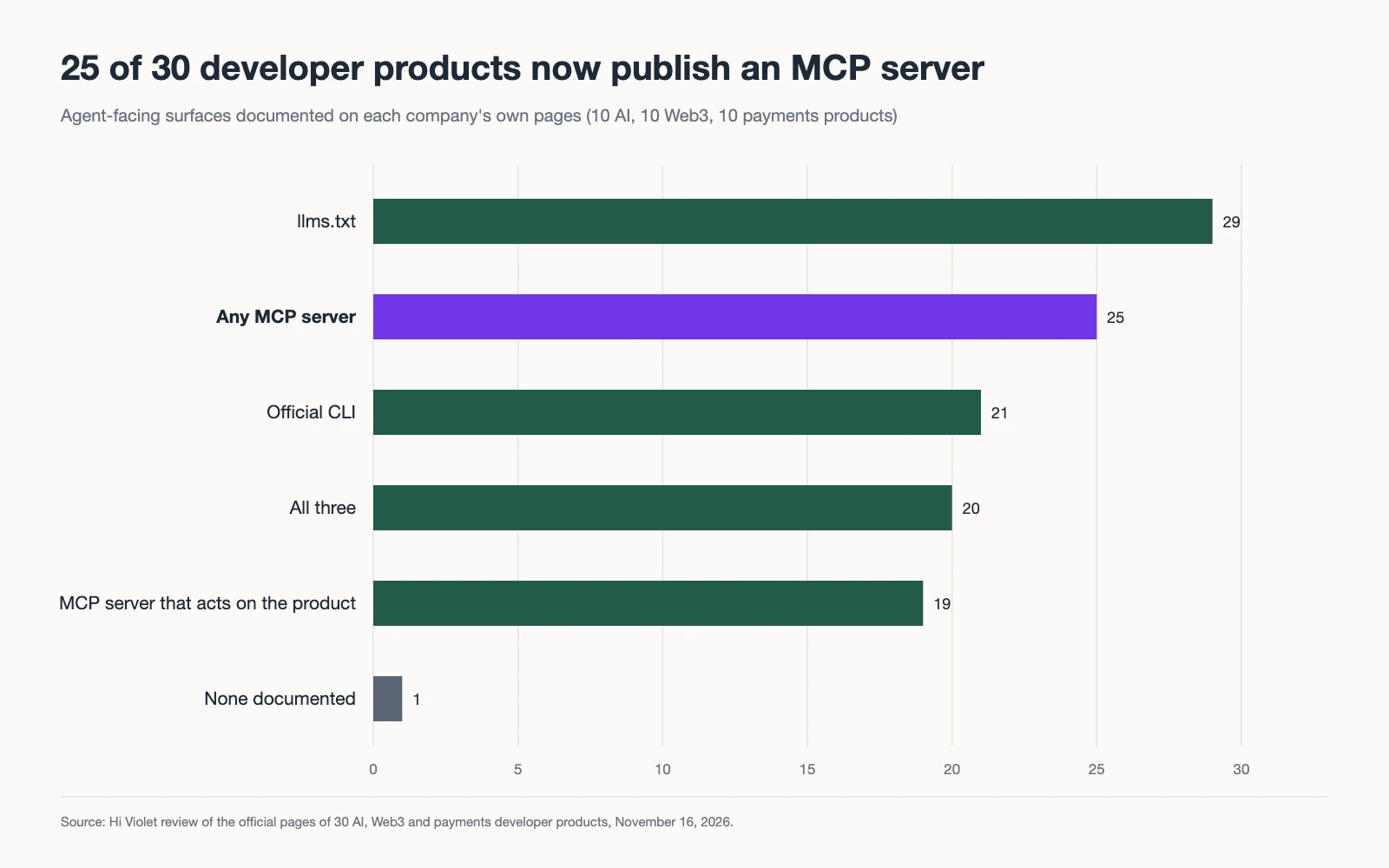
- Payments sites skip the commercial basics: 8 of the 10 payments products in the same panel never say on their own pages whether a card is needed before the first API call, though 9 of 10 publish an MCP server.
- Volume: x402 counts over 200 million transactions, but its real commercial volume was about $28,000 a day in March 2026.
Why did checkout move back to merchant sites?
Checkout moved back because in-chat checkout didn’t scale. CNBC reported in March 2026 that only about 30 Shopify merchants had gone live on Instant Checkout. Purchases now finish on retailers’ own websites, either in the ChatGPT app’s in-app browser or in a separate tab. An OpenAI spokesperson told CNBC that “Instant Checkout is moving to Apps.”
The next move confirmed the direction. On November 13, 2026, OpenAI launched ChatGPT Wallet with American Express, Chase, Mastercard and Visa. According to Digital Commerce 360, the wallet pays through existing retailer checkout systems. The card network issues a tokenized credential, so “neither the merchant nor the AI agent receives” the card details. OpenAI’s Commerce Partner Playbook asks retailers to keep product data current and to configure their CDN or firewall to recognize agent requests through Web Bot Auth.
So the agent arrives at your checkout and has to get through it. If your bot protection blocks it, your form needs a human, or your payment step only accepts a typed card number, the sale ends there. That’s an agent experience problem first and a payments problem second.
What do the main agent payment protocols do?
Each protocol answers one of four questions. Can an agent pay for this request? Can it check out and prove what the user approved? Can the merchant trust the agent? Can the payment stay private? The table sorts them on that basis.
| Rail | Settles in | Identity model | Who it fits | Maturity, Nov 2026 |
|---|---|---|---|---|
| x402 | Stablecoins (USDC and others) on EVM chains, Solana and more | Wallet signature on each payment; no account needed | APIs, data endpoints, MCP tools priced per call | Open standard under the x402 Foundation; 200M+ transactions, small real volume |
| Stripe MPP | Stablecoins, cards and buy now, pay later via Stripe | Stripe account on the seller side; agent authorizes each payment | Stripe merchants selling metered or recurring access to agents | Launched March 18, 2026; co-authored with Tempo |
| ACP + Shared Payment Tokens | Cards through the buyer’s payment provider | Single-use token scoped to one merchant, an amount and a time window | Merchants who want agent checkout while staying merchant of record | Open spec (Apache 2.0) from OpenAI and Stripe since September 2025 |
| Google AP2 | Cards, real-time bank transfers, stablecoins | Signed intent and cart mandates as verifiable credentials | Merchants and payment providers that need proof of user authorization | Announced September 2025 with 60+ partners |
| Google UCP | Google Pay at launch | Works alongside AP2 for payment authorization | Retailers selling through AI Mode in Search and Gemini | Announced January 2026 with Shopify, Etsy, Wayfair, Target and Walmart |
| Visa Trusted Agent Protocol | Visa card rails | Web Bot Auth signatures from approved agents | Card merchants that need to tell agents from bots | Announced October 2025 |
| Mastercard Agent Pay | Mastercard card rails | Agentic Tokens tied to an agent | Card merchants and issuers | Announced April 2025 |
| Skyfire KYAPay | Payment method carried in the token | One JWT with principal, platform and agent identity | Sites that want identity and payment in one credential | IETF individual Internet-Draft, July 2026 |
| PIVX Agent Kit | PIV, with shielded Sapling transactions | Agent-held wallet; one seed derives transparent and shielded addresses | Private agent-to-agent transfers and task payouts | Open-source Rust CLI and MCP server |
What is the difference between x402 and Stripe MPP?
x402 and Stripe MPP both price an HTTP request: the agent asks, the server names a price, the agent pays, and the resource comes back. x402 is an open standard with zero protocol fees that settles mostly in stablecoins. MPP, co-authored by Stripe and Tempo, runs through Stripe and accepts cards too.
One paid request over x402No account, no API key: the payment authorizes the request
Figure 1. One paid request over x402. The server answers the first request with a 402 and a PAYMENT-REQUIRED header. The agent retries with a signed PAYMENT-SIGNATURE, and a facilitator verifies and settles before the server returns the resource with a PAYMENT-RESPONSE receipt. Header names follow the x402 V2 docs.
With x402, payment works as authentication. The agent needs no account and no API key, just a wallet that holds the right asset on a supported network. That matters most for an agent that finds your endpoint mid-task and would otherwise stop at a signup form. Our x402 implementation guide covers facilitators, replay protection and pricing.
Stripe describes MPP the same way: “An agent can request a resource from a service, API, Model Context Protocol (MCP), or any HTTP addressable endpoint, and the service responds with a payment request.” The difference is the money behind it. Through Stripe’s PaymentIntents API, an MPP seller can accept stablecoins or cards and buy now, pay later via Shared Payment Tokens. Stripe says it supports both MPP and x402.
The practical split: if you already bill through Stripe and your buyers’ agents carry cards, MPP keeps everything in one ledger. If you want any agent with a stablecoin wallet to pay with no relationship to a processor, x402 is the more open path. Plenty of API businesses will end up offering both.
What is the difference between AP2 and ACP?
ACP standardizes a checkout and hands the merchant a payment credential it can charge. AP2 proves what the user actually authorized. They answer different questions, and a merchant meets both.
The Agentic Commerce Protocol is an Apache 2.0 spec from OpenAI and Stripe. Its key piece is the Shared Payment Token: a credential the buyer’s payment provider issues so the agent never holds the saved card, while the business stays merchant of record. ChatGPT was the first agent to implement it and Stripe the first payment provider. Instant Checkout is gone, but the spec stays open, and any merchant can implement it.
Google’s Agent Payments Protocol, announced in September 2025, is built around mandates. An Intent Mandate captures the original request. A Cart Mandate locks the exact items and price the user approved, which Google sums up as “what you see is what you pay for.” AP2 covers cards, real-time bank transfers and stablecoins. Google also launched an A2A x402 extension with Coinbase, so an AP2 flow can settle over x402.
The Universal Commerce Protocol, announced at NRF in January 2026, wraps the shopping journey from discovery to post-purchase support. Google says it works with AP2, A2A and MCP. For a retailer selling through AI Mode or Gemini, UCP is the integration, and AP2 sits underneath it.
Where do Visa, Mastercard and Skyfire fit?
They answer the trust question: is this agent who it says it is, and does a real person stand behind it? A merchant can’t safely accept an agent payment from traffic it treats as a bot.
Visa announced its Trusted Agent Protocol on October 14, 2025, built with Worldpay and Cloudflare. PYMNTS reported in the same story that AI-driven traffic to US retail sites had grown more than 4,700%. Mastercard Agent Pay came earlier, in April 2025, with Agentic Tokens built on the tokenization behind contactless and card-on-file payments.
Both rely on Web Bot Auth. Cloudflare explains that agents sign requests with HTTP Message Signatures and public-key cryptography. That gives the merchant a stable identifier at two moments: when the agent browses and when it pays. Cloudflare checks the signature, the key directory, the timestamp window, nonce uniqueness and a tag that says whether the agent is browsing or paying.
Skyfire goes further. Its KYAPay token draft defines a JWT that carries the human principal’s identity, the agent platform, the agent instance and, optionally, payment information. The draft argues that these tokens “provide a strong signal of human presence behind agentic requests that are otherwise indistinguishable from programmatic and potentially malicious bot requests.” It’s an individual Internet-Draft, not an IETF standard.
The same identity layer decides who gets into your free tier. Our guide to letting AI agents create accounts shows how to use signed agents in place of CAPTCHAs.
How do AI agents make private payments?
Agents make private payments with a wallet whose transactions don’t publish balances, history or counterparties. Stablecoin rails like x402 settle on public ledgers, where anyone can trace a wallet’s activity. The PIVX Agent Kit takes the other approach: shielded transactions by default for agents that need them.
The kit is a Rust CLI and MCP server that gives any compatible agent, including Claude Code, Cursor, OpenCode and Cline, its own PIVX wallet. PIVX describes Sapling-protocol shielded transactions where “No one sees your agent’s balance, transaction history, or counterparties.” According to the repository README, one seed phrase derives both a transparent address and a shielded address, and the wallet supports all four directions between them. Keys use device-bound encryption, and the spending key is derived when needed and then zeroized.
The kit also connects agents to PIVX Tasks, a bounty board “where agents and humans post, claim, and complete paid work in PIV.” Its MCP tools let an agent list, search, sign up for and submit tasks, and let a task creator approve or reject the work. Most payment rails assume the agent spends on someone’s behalf. This one lets an agent earn.
Disclosure: Hi Violet is affiliated with PIVX Labs.
Should a product support both x402 and PIVX Agent Kit?
Often, yes. x402 and the PIVX Agent Kit are separate rails, and PIVX does not run over x402. Each has a job the other doesn’t do well, and a product can support both in three ways.
Specific use cases. x402 is the right tool for a priced, metered HTTP endpoint: a data API, a per-call MCP tool, a paid report. The price sits in a header and the payment settles in a stablecoin. The PIVX Agent Kit is the right tool for private agent-to-agent value transfer and for task payouts where transaction privacy matters. That covers an agent that buys competitive research and doesn’t want its spending pattern public, and a protocol that pays contributors through bounties.
Overlapping use cases. A marketplace charges buyers’ agents per request over x402 and pays its workers’ agents through PIVX Tasks. Same product, two flows, each on the rail that fits.
Different audiences. A developer-tool company meets mostly stablecoin-holding coding agents. A privacy-focused Web3 community expects shielded payments. Offering both serves each group without forcing one rail on everyone. The consumer-crypto surface map shows how different Web3 audiences already are in where they show up and what they trust.
How much real volume do these rails carry?
Little, and the headline numbers overstate it. Forkast reported in August 2026 that x402 had passed 200 million transactions by June 2026. It also cited Artemis Analytics: more than 95% of that activity was “protocol signaling — machines testing the plumbing — not buyer-seller exchange.” Real daily commercial volume was about $28,000 in March 2026, per CoinDesk.
The same Forkast piece lists 40 member organizations in the x402 Foundation under the Linux Foundation, including Visa, Mastercard, Stripe, Google, AWS, Cloudflare and Coinbase. Infrastructure backing is broad. Buyer demand is small.
That gap is the reason to choose rails by behavior, not by transaction counters. It’s the same mistake our growth signal stack warns about: the easiest number to collect becomes the strategy by accident. And as the Courtyard GMV analysis showed, two labels for the same metric can sit 1,000 times apart. Accept the rails your buyers’ agents use today, and keep a cheap path open to the ones they’ll use next year.
Which agent payment protocol should you accept first?
Start where your buyer’s agent already pays, then add rails as runs show demand. The table gives a first move for common cases.
| If your product is… | Start with | Then add |
|---|---|---|
| A retail checkout selling physical goods | Card checkout agents can complete: Web Bot Auth allowlisting, network tokens, ChatGPT Wallet readiness | ACP Shared Payment Tokens; UCP if you sell through Google’s AI Mode |
| A metered API or data product | x402 for any wallet-holding agent | Stripe MPP if your billing already runs on Stripe |
| An MCP server or per-call tool | x402 priced per tool call | Stripe MPP sessions for recurring use |
| A SaaS product with a free tier and paid plans | An agent-completable free signup, then cards or MPP for upgrades | x402 for overage or one-off paid actions |
| A Web3 product with privacy-sensitive users | PIVX Agent Kit for private transfers | x402 for priced public endpoints |
| A marketplace that pays agents for work | PIVX Tasks for bounties and payouts | x402 for buyers’ agents paying per request |
| A payments or banking product | AP2 mandates for provable authorization | Visa Trusted Agent Protocol and Mastercard Agent Pay acceptance |
The metered-API and per-call rows rest on measured behavior, not preference. In the AX Panel, Claude Code and OpenAI Codex each built an API that “charges AI agents per API request without requiring them to create an account,” three runs apiece. All six chose x402. Claude Code settled through Coinbase’s facilitator; Codex picked PayAI because a seller can start without signing up for it. All six listed Stripe machine payments as an alternative and passed on it, because it needs a merchant account before the first paid request. Coding agents choose the rail with the fewest accounts between their code and the first payment, which is why x402 leads those rows. The full runs are in how AI agents choose tools.
The payments companies themselves show where the next gap sits. Across the 10 payments products in the panel, 9 publish an MCP server and 9 an llms.txt file, yet 8 of 10 never state on their own pages whether a card is needed before the first API call, and 7 of 10 never say what happens past a plan limit. The rails are ready for agents before the commercial facts are. Whatever rail you accept, publish the price, the card policy and the limits on a page an agent can fetch.
Two rules hold across every row. First, agent identity comes before payment: an agent your firewall blocks never reaches the payment step. Second, a rail you accept but never test is a guess. Untested rails fail in three ways: the agent can’t find the price, can’t parse the error, or gives up at a confirmation screen.
How Hi Violet tests agent payment flows
Hi Violet tests payment flows the way an agent meets them. We set a fixed list of tasks, such as “buy the starter plan,” “pay for one API call” and “pay out a completed task.” Then we run a fixed roster of coding agents, browser agents and assistants through them many times each, in sandboxed copies of your product.
Each step of each run is marked Cleared, Asked or Stopped. Cleared means the agent got through. Asked means it needed an answer your pages don’t give. Stopped means it gave up. For payments, the usual stops are a bot wall in front of checkout, a price the agent can’t find in machine-readable form, a 402 response it can’t parse, or a card form that assumes a human.
Then we fix what stopped the runs. That can mean allowlisting signed agents, adding an x402 endpoint, supporting PIVX Agent Kit payouts, opening a gated free signup, or granting temporary access so an evaluating agent can see the paid product. After that we re-run the same tasks. The score that matters is task completion, which is why we test with runs rather than readiness scores.
Read more about Hi Violet’s agent experience audits and how the agent runs work. If you want to know whether agents can pay you today, request access and we’ll scope the tasks with you.
Frequently asked questions
What is an agent payment protocol?
An agent payment protocol is a standard that lets an AI agent request, authorize and settle a payment without a human typing card details. x402 and Stripe MPP price individual HTTP requests. ACP, AP2 and UCP handle checkout and prove what the user approved. Visa’s Trusted Agent Protocol, Mastercard Agent Pay and Skyfire’s KYAPay let a merchant verify the agent.
What is the difference between x402 and Stripe MPP?
Both answer an HTTP request with a payment request and return the resource once the agent pays. x402 is an open standard with zero protocol fees that settles mostly in stablecoins. Stripe MPP, co-authored with Tempo and launched on March 18, 2026, runs through Stripe and accepts stablecoins, cards and buy now, pay later. Stripe supports both.
What is the difference between AP2 and ACP?
ACP, published by OpenAI and Stripe under Apache 2.0, standardizes checkout and gives the merchant a Shared Payment Token instead of the saved card. Google’s AP2 records what the user authorized in signed Intent and Cart Mandates. It works across cards, bank transfers and stablecoins, and it can settle over x402 through the A2A x402 extension.
Can AI agents make private payments?
Yes. The PIVX Agent Kit gives an agent its own PIVX wallet through a Rust CLI and MCP server. Shielded Sapling transactions hide the agent’s balance, transaction history and counterparties. Stablecoin rails such as x402 settle on public ledgers, so a wallet’s activity can be traced.
Should a product support both x402 and PIVX Agent Kit?
Often, yes. They’re separate rails with different jobs. x402 suits priced HTTP endpoints settled in stablecoins. The PIVX Agent Kit suits private agent-to-agent transfers and bounty payouts. A product needs one for a specific use case, both for overlapping flows such as charging buyers and paying workers, or each for a different audience.
Which payment rail do AI coding agents choose?
x402, in Hi Violet’s runs. In the AX Panel 2026, Claude Code and OpenAI Codex were each asked three times to build an API that charges AI agents per request without accounts. All six runs chose x402 and passed on Stripe machine payments because it needs a merchant account first. Claude Code settled through Coinbase’s facilitator and Codex through PayAI.
Which agent payment protocol should I accept first?
Start where your buyer’s agent already pays. Retailers should make card checkout work for agents, with Web Bot Auth allowlisting and network tokens. Metered APIs should start with x402 or Stripe MPP. Web3 products with privacy-sensitive users should add the PIVX Agent Kit. Then run real agent tasks against every rail you accept.