Do AI UGC Ads Actually Convert? What 300,000 Live Ads Show
Yes on the click: AI ads drew 0.76% click-through against 0.65% for human ads across 300,000 Taboola ads. Humans win the purchase, so brands use AI for 100 variants at $1.
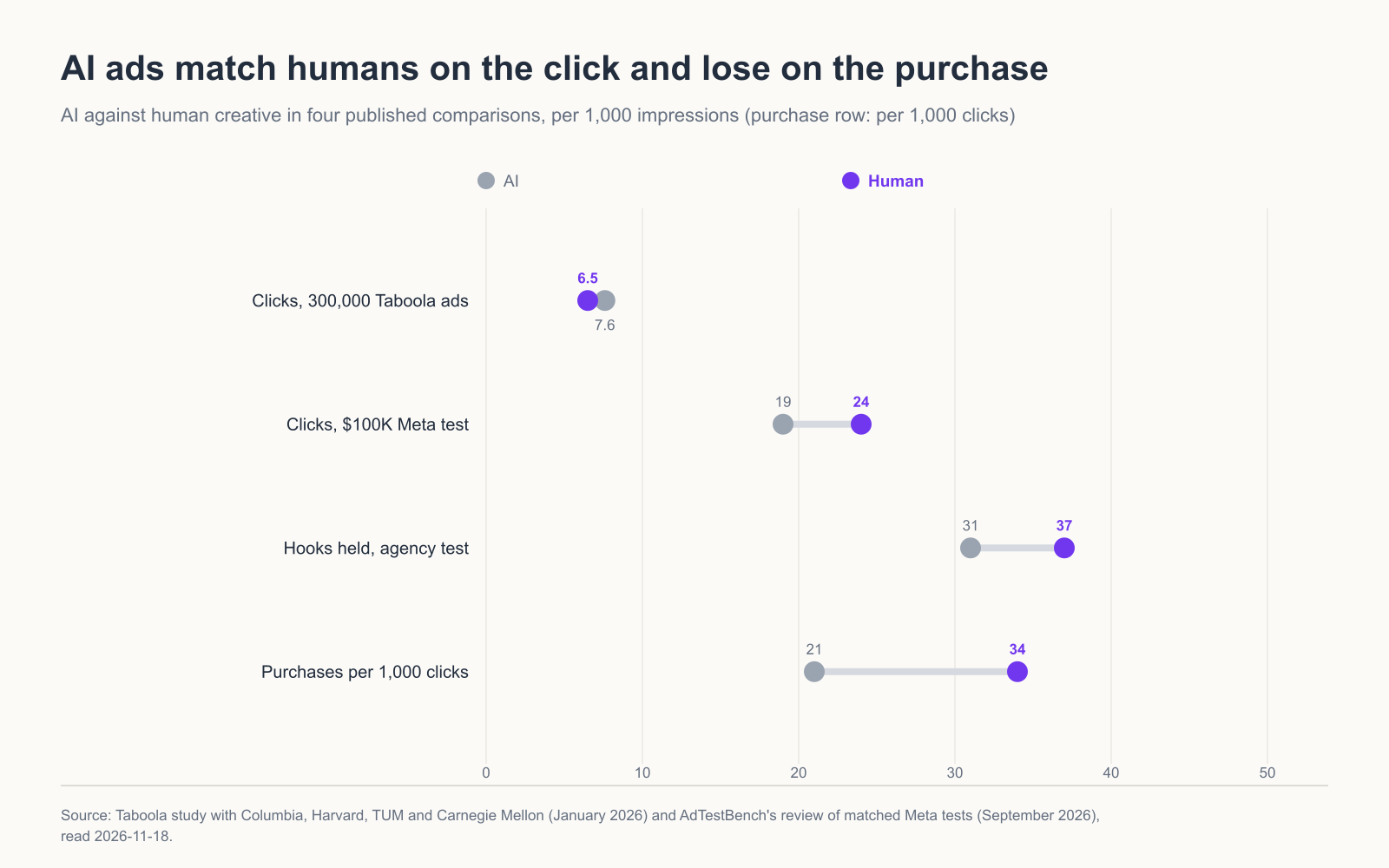
Yes, AI UGC ads convert, and on the click they convert about as well as human creative. Across more than 300,000 Taboola ads, AI-generated creative drew a 0.76% click-through rate against 0.65% for human-made ads, and the AI ads that did not read as AI beat both. Human creators still win the purchase. In a $100K Meta test, human UGC took the click at 2.4% against 1.9%, and in an agency test it turned clicks into purchases at 3.4% against 2.1%.
Brands run AI UGC anyway because of arithmetic. One operator puts out 100 AI UGC videos in under an hour at about $1 each, against $150 to $280 for one human creator video. That buys 100 hook variants for the price of one creator day.
Key findings
- AI-generated ads drew a 0.76% click-through rate against 0.65% for human-made ads across 300,000 ads on Taboola, and matched them after controls.
- In Ipsos and Syracuse University’s test of 20 ads with 3,000 US consumers, human-made ads scored 14% higher on short-term sales effect and 17% higher on long-term brand equity.
- Only 25% of viewers spotted that an AI ad was AI-made and 40% were unsure.
- An AI UGC video costs $1 to $12 to produce against $150 to $280 for a human creator video.
- In a $100K Meta test across 220 creatives, human UGC won click-through 2.4% to 1.9% and AI won return on ad spend 2.8x to 2.3x.
- Of the 1,227 Reddit posts we pulled, 29 name AI UGC, and the most upvoted operator thread is a producer making 600 videos a month at $2 to $3 each.
What is AI UGC?
AI UGC is a creator-style ad in which the person on camera is generated, built from a script, a face library and a setting library, and produced in volume for paid social.
It looks like a customer filming a phone selfie in a car or a kitchen, holding up the product and talking about a problem. Nobody was filmed. The face comes from an image model, the motion from a video model such as Seedance or Wan, and the voice from a speech model. A skincare demo made in Arcads is the standard example: pick the AI creator, paste the script, generate variations.
69 of the 480 X posts and 53 of the 1,227 Reddit posts we pulled mention UGC, and 29 of the Reddit posts name AI UGC.
How are AI UGC ads made?
AI UGC ads are made on a fixed production line: operators pull angles from the Meta Ad Library and competitor one-star reviews, write a script under 85 words with the problem in line one, pick an age-matched face from a library of five, place it in one of five settings, generate a voice with room tone, and render variants in batches.
The clearest public version is a folder tree posted by CEO_Vlad. Angles: the Meta Ad Library, ads live 30 or more days, competitor one-star reviews, customers’ own words. Scripts: problem in line one, product before halfway, under 85 words, read it out loud. Avatars: age matched to the claim, five faces per account. Settings: car, bathroom, kitchen, store aisle, desk. Voice: room tone matched, stumbles left in. zackpaid’s system doc opens with 54 UGC ads across 14 niches pulled live from the Meta Ad Library, and states the consensus: the video is the easy part, the script gets you customers.
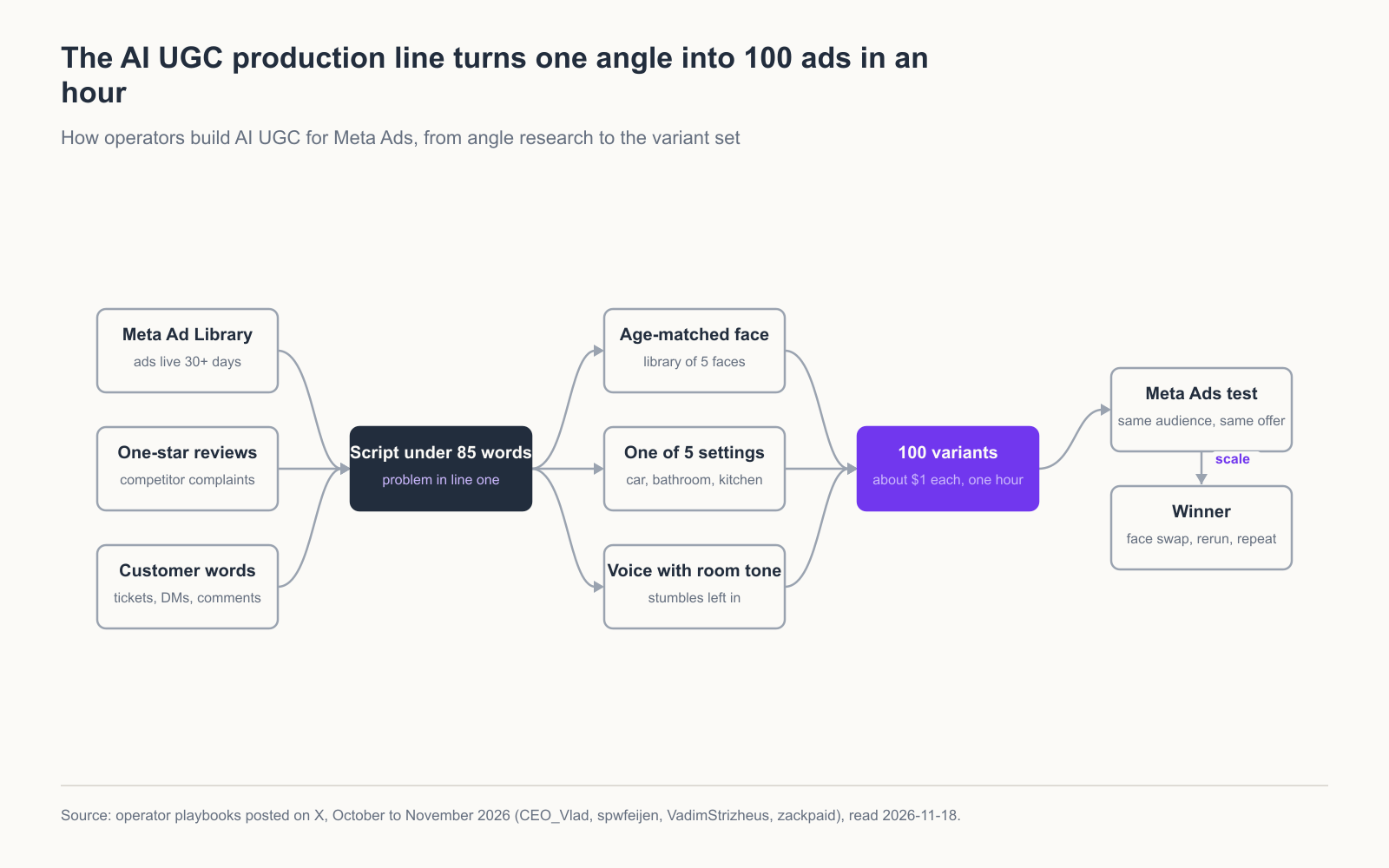
Figure 1. The AI UGC production line as operators describe it on X, from angle research to the variant set and back.
spwfeijen’s line produces 100 AI UGC videos in under an hour at about $1 each, with Claude writing the script and MakeUGC plus Seedance 2.5 generating the footage. The rule that makes it cheap: approve every still before animating, because a failed image costs cents and a failed video costs dollars. The producer behind the 600-videos-a-month AMA, 93 upvotes and 60 comments, lands at $2 to $3 a video: two hours on a client’s first video, then 30 to 40 minutes each and 15 per hook swap. Keeping one face stable across 600 renders is covered in our post on the consistent-character pipeline.
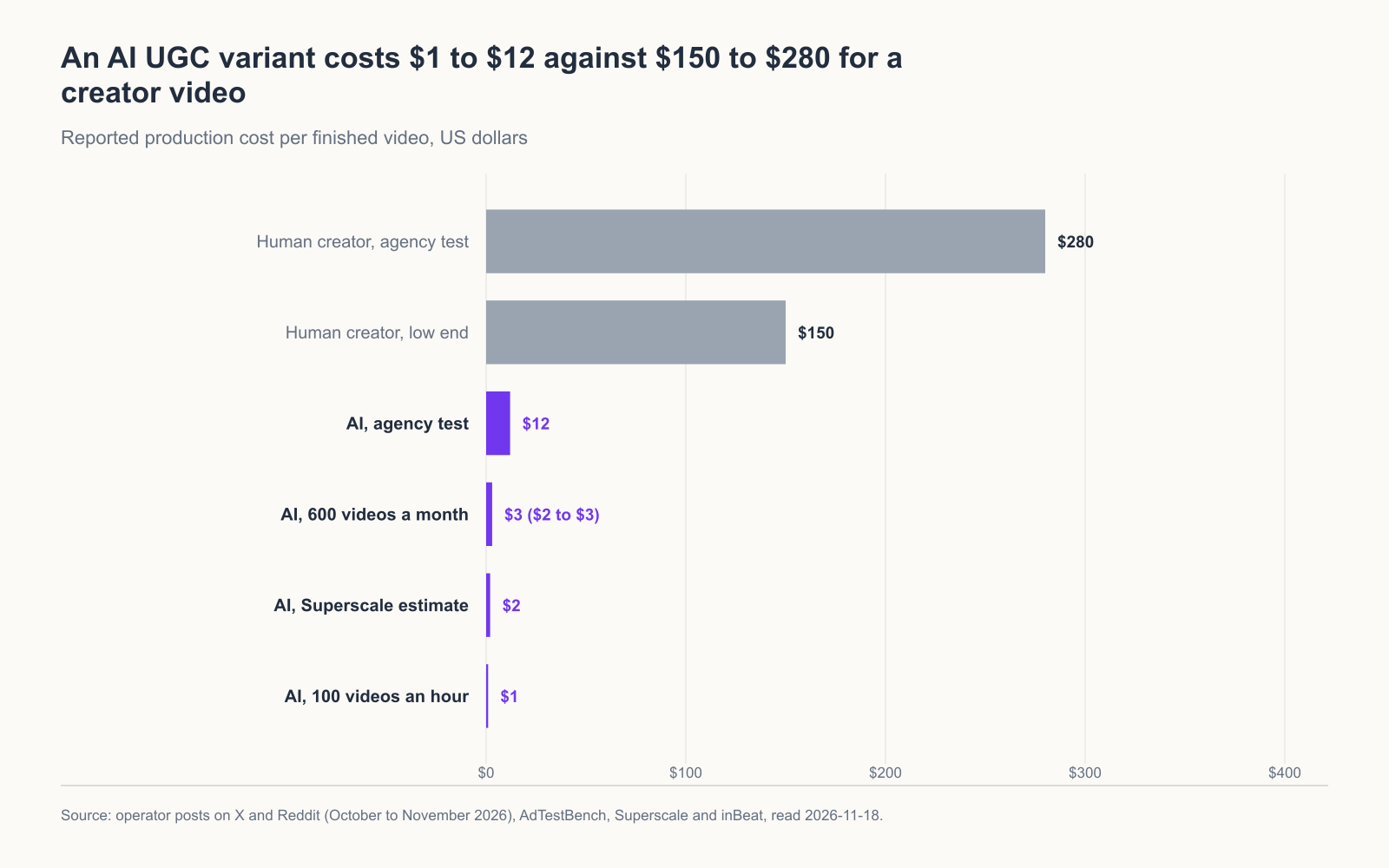
Figure 2. Reported production cost per finished video, from operator posts and the published comparisons.
inBeat puts real UGC at $150 to $500 per video depending on usage rights, and Superscale at $150 to $212 and two to three weeks, against $2 and 16 minutes for AI. Rerenders are why the most discussed first render in r/AI_UGC_Marketing is titled “Costs much more than I expected”, 33 upvotes and 43 comments. Our post on AI content farm economics puts these unit costs in context.
Do AI UGC ads convert?
AI UGC ads convert on the click and lose to human creators on the purchase: AI creative matched human creative at 0.76% against 0.65% click-through across 300,000 Taboola ads, Ipsos found human ads 14% stronger on short-term sales effect, and inBeat’s campaign data shows AI UGC cutting cost per result by up to 28% when it wins.
The largest study is the Taboola analysis with Columbia, Harvard, the Technical University of Munich and Carnegie Mellon, published in January 2026 as AI in Disguise on SSRN. The method is sibling ads: AI and human creatives from the same advertiser, same campaign, same day. In the raw data AI ads drew 0.76% click-through against 0.65%, and after controls the two perform the same. AI ads that read as human-like beat both human-made ads and ads that looked machine-made.
AdTestBench reviewed 12 published Meta tests, and six put human UGC ahead per ad. The largest, a $100K test over three months across 220 creatives, had human UGC winning click-through 2.4% against 1.9% and AI winning return on ad spend 2.8x against 2.3x. An agency test across three clients ran the human’s way at every step: hook rate 3.7% against 3.1%, click-to-purchase 3.4% against 2.1%, production cost $280 against $12. That same-ad-set comparison is how we run creative testing inside Meta Ads management.
Figure 3. AI against human creative per 1,000: 7.6 against 6.5 clicks on Taboola (0.76% against 0.65%), 19 against 24 clicks in the Meta test, 31 against 37 hooks held, 21 against 34 purchases per 1,000 clicks.
The purchase gap has a measured cause. Ipsos and Syracuse University’s Newhouse School took 10 ads from major brands, generated an AI counterpart for each in Sora 2, and tested all 20 with 3,000 US consumers. Human-made ads scored 14% higher on the Creative Effect Index, the short-term sales measure, and 17% higher on the Equity Effect Index, the brand measure. Only 25% of viewers were at least somewhat confident an AI ad was AI-made, and 40% were unsure.
AI won where the brief was direct (Cheerios, 155 against 148 for the human version) and lost where it asked for emotion (Chewy, 180 against 115). That is the UGC brief: a clear problem, a clear product, no story required.
| Study | Sample | Metric | Result |
|---|---|---|---|
| Taboola with four universities, January 2026 | 300,000+ ads, 500M impressions | Click-through | AI 0.76%, human 0.65%, equal after controls |
| Ipsos and Syracuse University, 2026 | 20 ads, 3,000 US consumers | Creative Effect Index, Equity Effect Index | Human +14% and +17% |
| $100K Meta test via AdTestBench, 2026 | 220 creatives, three months | Click-through, return on ad spend | Human 2.4% vs 1.9%, AI 2.8x vs 2.3x |
| Agency test via AdTestBench, 2026 | 3 clients, six weeks | Hook rate, click to purchase | Human 3.7% vs 3.1% and 3.4% vs 2.1% |
| inBeat campaign review, April 2026 | Live campaigns | Cost per result, CPA | AI up to 28% and 31% lower when it wins |
Why do brands use AI UGC?
Brands use AI UGC for volume: it lets a brand test 100 hooks, faces and settings for the price of one creator video, find the two that hold attention, and put the media budget behind those, because the single AI video rarely beats the single human video while the hundredth variant beats the brief.
inBeat’s review of live campaigns reports AI UGC delivering up to 28% lower cost per result and 31% lower cost per acquisition where it won, and attributes the gap almost entirely to testing more script and hook variants for the same budget. Billo’s write-up of the Ipsos data draws the same line: the AI set tests, the human asset sells.
The loop is short. VadimStrizheus states it in four lines: grab your organic winners, face swap them with AI influencers, run them on Meta Ads, repeat, for hundreds of AI UGC ads at under $10.
The question is whether 100 AI variants at $1 find a winner faster than four creator videos at $200. Pricing that trade against creator spend is the job of paid growth.
When does AI UGC fail?
AI UGC fails when the ad has to carry trust rather than a hook: before-and-after proof, emotional testimonials, supplements and other trust-heavy categories, TikTok Shop affiliate content, and any placement where a platform label or a scam association turns the viewer off. It also fails as a service sold to brands that already run the tool in house.
A supplements store in AdTestBench’s review spending $30,000 to $80,000 a month paid 1.6 to 2.2 times the CPM and earned 0.4 to 0.6 of the return on AI creative. ButterCut lists the same human wins on Meta: transformation content, emotional stories, product demos and trust-dependent categories.
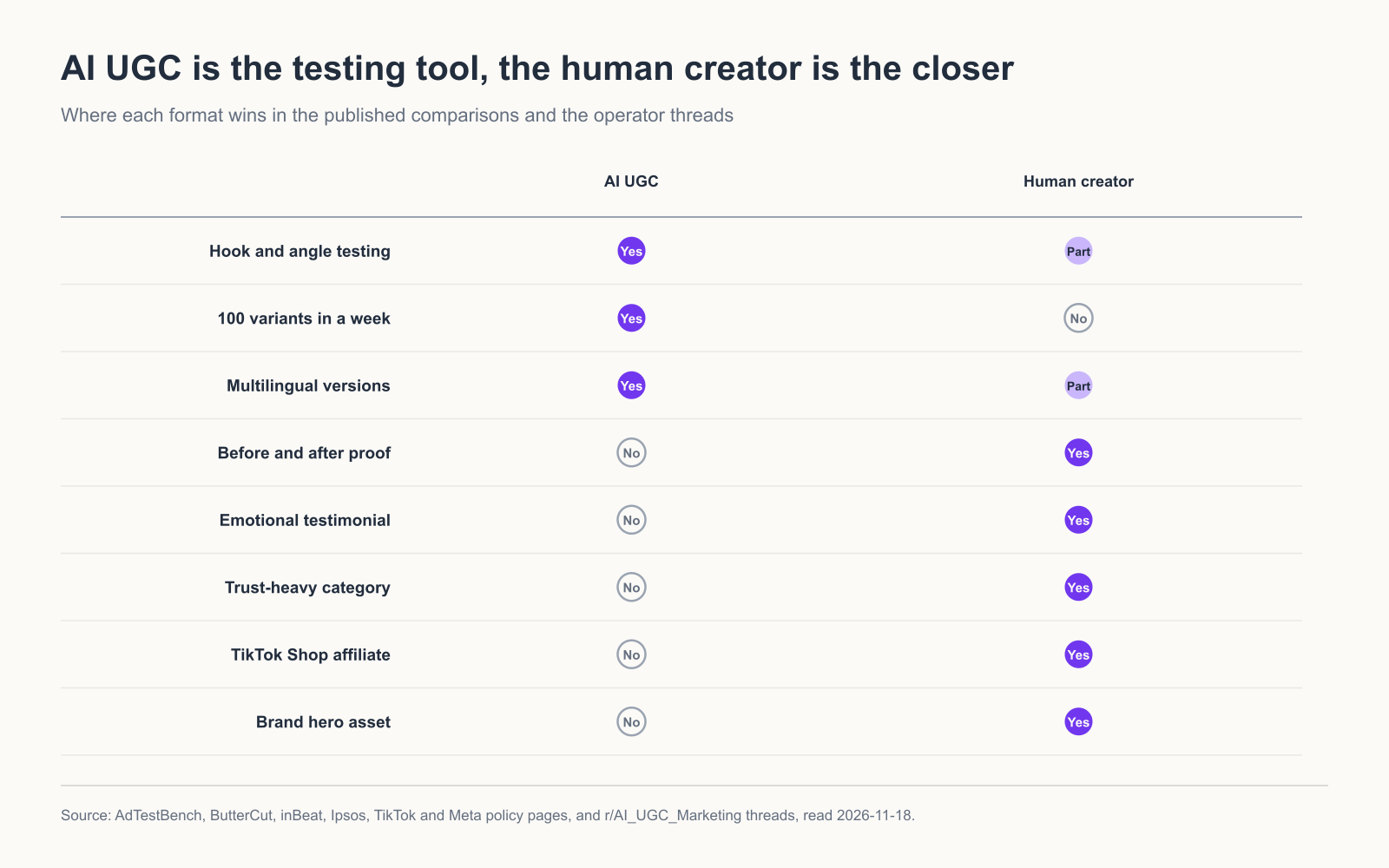
Figure 4. Where each format wins, from the published comparisons, the platform rules and the operator threads.
The second failure is commercial. “No brands are paying you for your UGC. Stop lying about it”, 43 upvotes and 23 comments, comes from an agency-side poster: brands with a creative budget have marketers in house who prompt it themselves. The follow-up, 46 comments, puts AI UGC at concepting and testing and names the platform problem: TikTok’s AI label cuts an affiliate video’s credibility.
| Platform | Rule | What happens |
|---|---|---|
| TikTok | Label AI-generated or significantly edited content that shows realistic-looking scenes or people | Unlabeled content is removed, restricted or labeled, and loses the For You feed |
| TikTok Shop | AI content that misleads, deceives or impersonates is not allowed in Shop content | Content removal or account suspension |
| Meta ads | AI info label on ads created or significantly edited with Meta’s generative tools, next to Sponsored when the human is AI-generated | The label shows to every viewer |
Our post on AI content monetization rules covers the organic side.
The third failure is association. In November 2025, Reuters reported from internal Meta documents that Meta projected about $16 billion, around 10% of its 2024 revenue, from ads for scams and banned goods. Mark Cuban’s reaction thread drew 32,012 upvotes and 587 comments in r/technology. An AI face selling supplements sits one swipe from the format those scams use, and 79% of viewers in the Ipsos study want AI use disclosed.
An AI UGC test plan for Meta Ads
- Pull the angle from evidence. Meta Ad Library ads live 30 or more days, competitor one-star reviews, your own support tickets.
- Write to the 85-word ceiling. Problem in line one, product before halfway, read it out loud.
- Build the grid, then approve the stills. Five faces, five settings, four hooks is 100 variants.
- Run AI and human in the same ad set. Same audience, offer, landing page and week. Judge on cost per purchase, not click-through.
- Set the kill rule before launch. Hold-rate and cost-per-purchase thresholds, and the impression count that triggers them.
- Disclose where the platform asks. Toggle the AI label on TikTok, expect the AI info label on Meta, keep AI faces out of TikTok Shop affiliate content.
- Hand the winning script to a human. A creator does the transformation, testimonial and trust-heavy versions, where the human earns the 14% and 17%.
- Read it inside the account. A platform click-through rate with no within-account comparison is the trap the ChatGPT Ads burn posts fell into. The measurement post covers what a clean read needs.
This is how Hi Violet runs AI UGC variant testing inside Meta Ads management and prices the variant set against creator spend in paid growth. The AI set finds the angle, and the human creator closes where the data says the human wins. If you want the test run on your account, request a strategy call.
How we did it
We pulled 480 X posts from 2026-09-01 to 2026-11-18 across eight searches through Apify’s tweet scraper by apidojo, and 1,227 Reddit posts from the last 30 days across 43 searches through Apify’s Reddit scraper by harshmaur. We counted the posts that mention UGC (69 on X, 53 on Reddit) and the Reddit posts that name AI UGC (29, of which 11 sit in r/AI_UGC_Marketing). The study numbers come from the Taboola release and its SSRN paper, the Ipsos and Syracuse University report, AdTestBench’s review of 12 matched tests, and the inBeat, Billo, ButterCut and Superscale write-ups. The platform rules come from TikTok’s Community Guidelines, TikTok Shop’s seller guidance and Meta’s newsroom post on AI info labels, and the scam-ad figures from Reuters’ November 2025 reporting. We read every source on 2026-11-18.
FAQ
Do AI UGC ads actually convert?
Yes on the click, and human creators still win the purchase. AI creative drew 0.76% click-through against 0.65% for human ads across 300,000 Taboola ads. In a $100K Meta test, human UGC won click-through 2.4% to 1.9% and AI won return on ad spend 2.8x to 2.3x.
What is AI UGC?
AI UGC is a creator-style ad in which the person on camera is generated, built from a script, a face library and a setting library, and produced in volume for paid social. One operator ships 100 of them in under an hour at about $1 each.
Is AI UGC better than real UGC?
Not per ad. In the 12 published Meta tests AdTestBench reviewed, six put human UGC ahead, and Ipsos found human ads 14% stronger on short-term sales effect and 17% on brand equity. AI UGC wins on volume: 100 variants at about $1 each against $150 to $500 for one creator video.
How much does an AI UGC ad cost to make?
Between $1 and $12 per finished video. Operators report about $1 at 100 videos an hour and $2 to $3 at 600 videos a month, and an agency test logged $12 for AI against $280 for the human version. Human creator videos run $150 to $500.
Do you have to disclose AI UGC ads on Meta and TikTok?
TikTok requires a label on AI-generated content that shows realistic-looking scenes or people, and unlabeled videos are removed, restricted or kept off the For You feed. Meta applies an AI info label next to Sponsored when the human in an ad is AI-generated. 79% of viewers in the Ipsos study want the disclosure.
Why are brands not paying for AI UGC?
Brands with budget run AI UGC in house as a testing tool rather than buying it as finished creative. The most argued thread in r/AI_UGC_Marketing, 43 upvotes and 23 comments, makes that case, and the follow-up puts AI UGC at concepting and testing.
How do you test AI UGC against human creators?
Run both in the same ad set with the same audience, offer, landing page and week. Judge on cost per purchase rather than click-through, because AI won the click and lost the purchase in 3 of the 4 published comparisons. Set the kill thresholds before launch.