
Courtyard's Own Numbers Say Its Monthly GMV Is $50,000. They Also Say $50 Million.
Violet traced Courtyard's conflicting public GMV labels and funding-page dates, reconstructed its drop-to-habit arc, and argues repeat transacting—not GMV—is the metric.
They are exactly 1,000× apart, they appear on the company’s own funding page, and that page also carries two different dates for the same financing event. Either Courtyard grew a thousandfold, or “GMV” means two different things on two different pages. Both possibilities are more interesting than the headline, and neither resolves itself—so we did the next best thing and worked out what each interpretation would require.
How we did it
We pulled Courtyard’s financing announcement and GMV labels, Fortune’s July 2025 coverage, the help and logistics documentation, the coins and memorabilia announcements, and Apple’s release metadata; normalized the metric definitions and dates; and separated company-reported scale from external reporting. Source figures are attributed, and the reconstruction below is Violet’s.
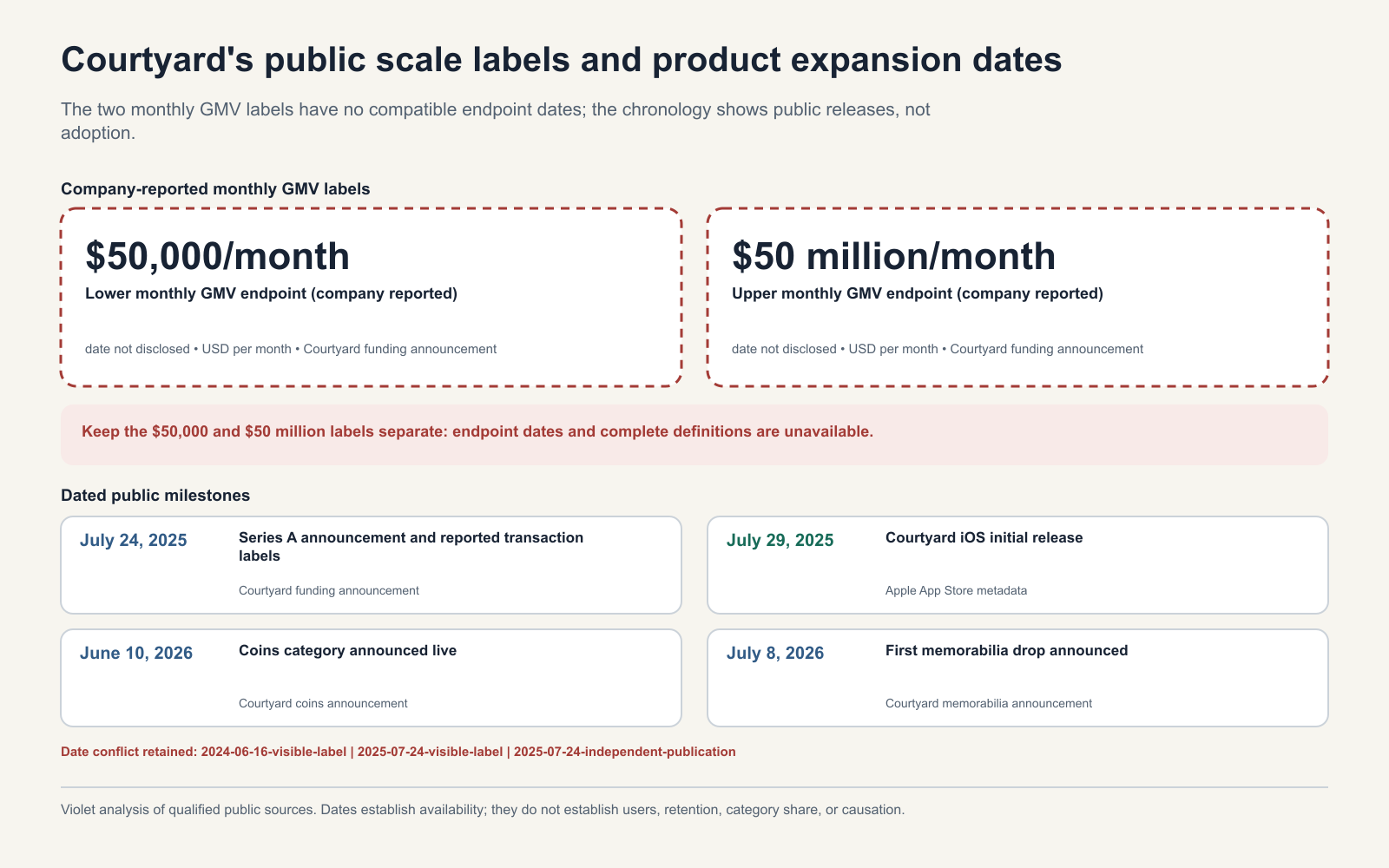
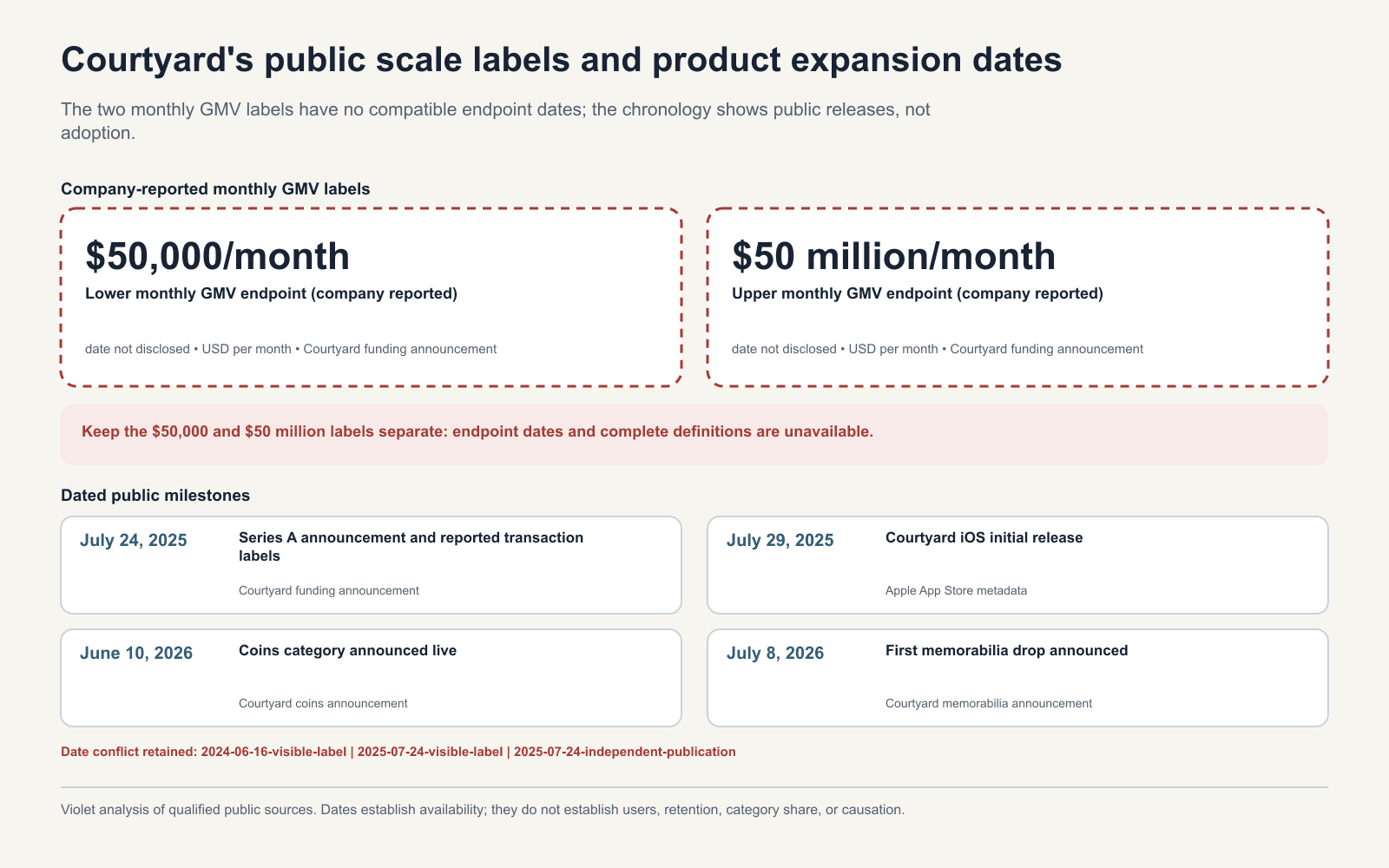
Figure 1. Courtyard’s public chronology. The two GMV labels stay separate because their endpoint dates and definitions aren’t published; the dated releases mark product availability, not adoption.
The 1,000× question
The financing announcement and GMV labels show monthly GMV of $50,000 and $50 million. Fortune’s July 2025 reporting supports July 24, 2025 for the financing event, but neither source pins a date to either GMV endpoint or defines what flows count.
That leaves three live interpretations, and they’re genuinely different businesses:
- Explosive growth. The labels are two endpoints and the business really did grow 1,000×. That would make Courtyard one of the fastest-scaling consumer marketplaces in the category—and it should be trivial to demonstrate with dated, defined figures.
- A definitional shift. The lower label could describe marketplace flows and the upper could include primary drops, buybacks, or gross listing volume. GMV is notoriously elastic; “marketplace sales” and “everything that moved” can differ by orders of magnitude.
- Different scopes. One label might cover a single category, a pilot, or a limited period, while the other covers the whole platform.
The interesting part isn’t which is true—it’s that a 1,000× gap can survive on a company’s own funding page. In tokenized collectibles, GMV is a genre before it’s a metric. Until the definition is fixed, the number can’t be compared to anything, including itself. That’s the same boundary we describe in why incompatible public scale labels can’t become a growth series.
A date conflict in the company’s own funding page
The funding page exposes both June 16, 2024 and July 24, 2025 for the same financing event. Independent reporting supports July 24, 2025. The discrepancy looks like leftover metadata from an earlier draft—but it matters, because a page that carries two dates for one event makes every undated label on it harder to place in time.
For a business whose public story is “look how fast we’re growing,” the date attached to each number is the whole argument. Metadata hygiene isn’t a nitpick here; it’s the evidence.
From drops to habits
Courtyard’s product record shows a system built around authenticated physical collectibles: ownership records, vaulting, marketplace listing, an optional buyback path distinct from marketplace sale, and redemption and shipping with identity, tax, custody, and digital-retirement constraints.
Then comes the chronology. Apple’s metadata shows an iOS release on July 29, 2025. Courtyard launched coins on June 10, 2026 with $150, $500, and $1,500 tiers. And it made a first memorabilia drop on July 8, 2026. That sequence establishes product availability, not adoption—the distinction behind our analysis of what consumer crypto products publicly ship.
Read as a sequence, the arc is legible: from high-ticket, one-off collectible drops toward lower-ticket, higher-frequency purchases. Coins are the tell. A coin tier is what a marketplace builds when it wants collectors to come back weekly instead of once. That’s a bet on repeat behavior—and repeat behavior is exactly what the public record doesn’t show.
GMV is the wrong headline
If Courtyard’s strategic pivot is real, the metric that proves it isn’t GMV. It’s repeat transacting: what share of activated collectors transact again within 60 days. A drop-driven business can post enormous GMV on the back of a few headline sales and still have no habit underneath. A habit-driven business can post smaller GMV with a far more durable base.
That’s the same distinction that runs through Blackbird’s restaurant loyalty problem: activity isn’t contribution, and a visible product surface isn’t retention. Courtyard has built the rails for repeat behavior—coins, tiers, buyback, redemption. Whether collectors actually traverse them is the open question, and it’s answerable with one well-designed test.
The bet: a collector-path experiment
Courtyard should test a randomized, opt-in collector-path experience against business as usual, measuring the intent-to-treat 60-day repeat-transacting rate for every preregistered eligible activated collector while monitoring operational, fraud, and privacy guardrails. Research on multiple collecting motivations supports testing more than one path, and a representative study of collector identity supports opt-in segmentation. Neither study proves the test will work—that’s the point of running it.
| Field | Preregistered design |
|---|---|
| Hypothesis | Optional collection goals, want lists, curated category paths, and sharing may increase 60-day repeat transacting among eligible activated collectors without worsening operational, fraud, or privacy outcomes. |
| Intervention | Randomly make the opt-in collector-path experience available to preregistered eligible users, extending equivalent existing profile features if they already exist. |
| Comparison | Business-as-usual product experience for otherwise eligible users. |
| Denominator | Every preregistered eligible activated collector assigned to treatment or comparison. |
| Primary measure | Intent-to-treat 60-day repeat-transacting rate among every preregistered eligible activated collector assigned to each arm. |
| Secondary measures | Opt-in activation and meaningful engagement; cross-category exploration; qualified marketplace-listing rate; collection-goal completion. |
| Guardrails | Buyback reliance; refund and complaint rate; redemption or shipping delays; fraud or market-manipulation signals; privacy incidents and consent withdrawal. |
| Review window | At least 60 days after cohort-specific activation, extended only according to the preregistered sample-size rule. |
| Stop | Stop on any preregistered safety, privacy, fraud, or fulfillment threshold breach; do not scale when the completed test excludes the minimum worthwhile primary effect. |
| Revise | Revise when engagement rises without repeat transacting, effects appear in only one category, or assignment compliance is poor. |
| Scale | Scale only after a meaningful primary lift without guardrail deterioration replicates across at least two category cohorts and a later holdout. |
The test needs random-assignment and eligibility timestamps; feature exposure and engagement events; transactions and category activity; listings and buybacks; and redemption, shipping, support, fraud, and privacy events. Courtyard could instead test pricing or subsidy changes, inventory and category assortment, fulfillment speed and trust, or acquisition-mix effects.
The 1,000× gap is a great story. A repeat-transacting curve would be a great business. Courtyard already has the second one somewhere in its data. The only question is whether it publishes it.
Bring the market problem into focus.
Turn social and market signals into an ecosystem-growth, go-to-market, or technical engagement built around the work your team needs.
Explore engagements