
From Commit to Customer: A Shipping-to-Demand System for Technical Products
A practical operating system for translating meaningful product changes into clear explanations, useful distribution, measurable action, and market learning.
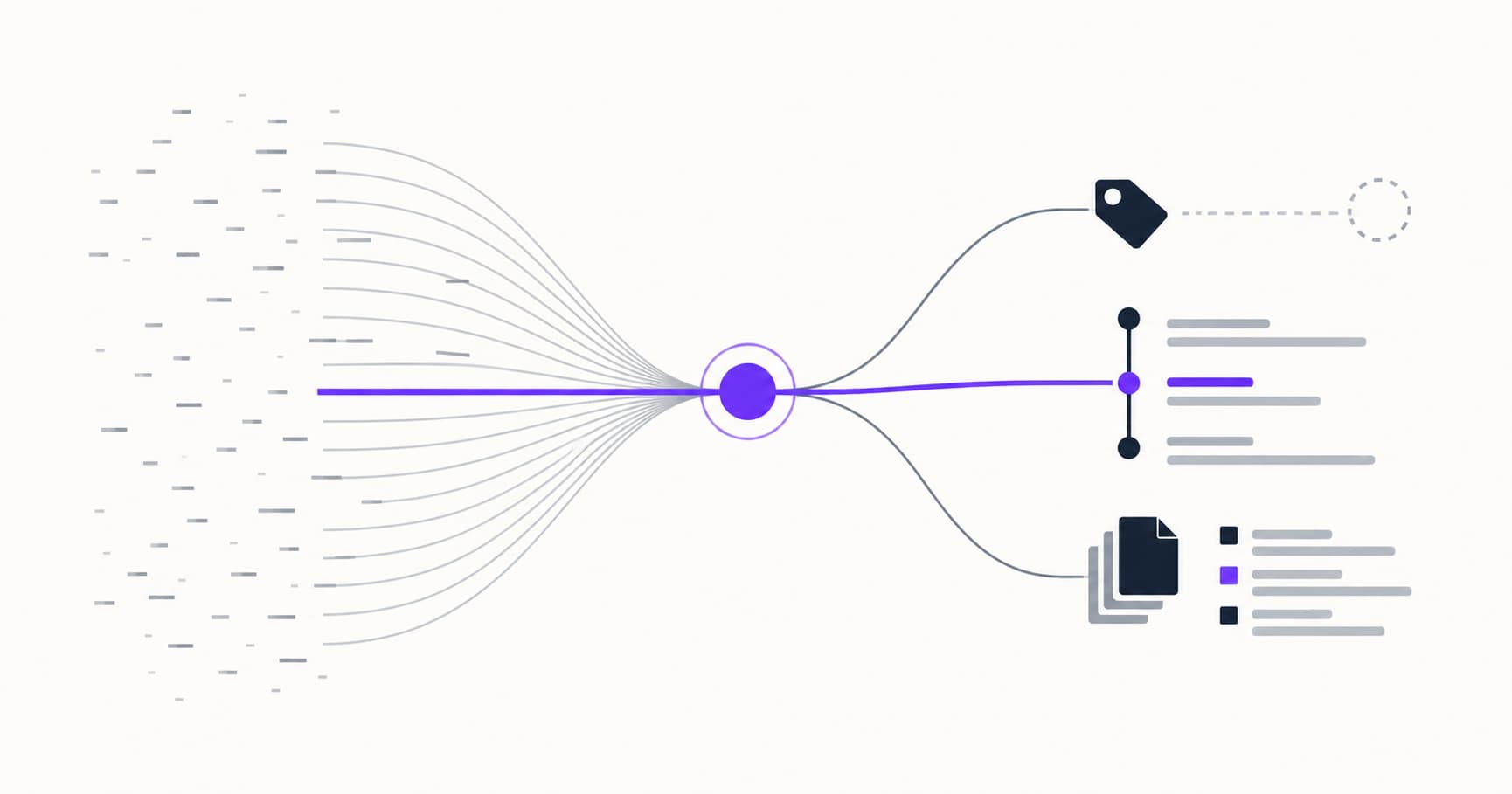
Shipping and distribution are different jobs. A repository can show meaningful public activity while the market still lacks a clear explanation of who should care, what changed for them, and what to do next. Conversely, a polished announcement can travel widely without proving that a meaningful product change occurred.
Treat the release as source material, translate it into a customer consequence for a named audience, distribute that explanation with one next action, and measure the path to activation. The growth decision is not how many assets to publish. It is how to make a verified change understandable, actionable, and capable of producing useful market learning.
Violet’s 16-product repository study establishes the evidence problem: a release-only check missed qualifying recent public activity.
At a glance
| Growth-leader question | Decision |
|---|---|
| Does a release page contain the complete shipping record? | No. Verify releases and qualifying commit/file evidence separately. |
| What should a release explanation lead with? | The affected user, previous constraint, new consequence, and proof. |
| How many derivative assets should a release create? | Only those with a distinct audience or message job and one next action. |
| What should be measured? | Exposure, comprehension, qualified action, activation, and retained use as separate stages. |
| What does repository activity prove? | A bounded public technical signal. |
The workflow begins by protecting technical truth, then asks the market to do something observable with it.
Shipping public signal
Within the frozen 180-day window, Violet verified qualifying public repository identities for 15 of 16 selected products and observable public-shipping signals for 14; one verified repository had no qualifying recent signal, and one product identity remained unresolved.
Five verified repositories returned complete empty latest-release pages; four of those repositories still had qualifying recent commit or file evidence, while one had no qualifying recent public signal. Six observable public-shipping states depended on qualifying commit or file evidence rather than an in-window latest release.
GitHub defines a release as a deployable iteration built around a tag. That makes it one specific publishing object—not a universal receipt for every product change.
The verified repository surfaces include MetaMask, Uniswap, PancakeSwap, Jupiter, Magic Eden, Rarible, and Zora. A changelog and a conventional commit history are two additional publishing objects with their own audiences and standards.
| Public evidence state | Products or repositories | What it establishes |
|---|---|---|
| Verified qualifying repository identity | 15 of 16 products | An accepted public technical surface |
| In-window latest release | 8 repositories | An observable release-level signal |
| Older latest release | 2 repositories | A release outside the window; check commit/file evidence separately |
| Complete empty latest-release page | 5 repositories | No returned release; check commit/file evidence separately |
| Observable public-shipping signal | 14 of 16 products | An in-window release or qualifying recent commit/file artifact |
| No recent qualifying public signal | 1 product | No qualifying signal on the accepted public surface |
| Repository identity unresolved | 1 product | No repository-level classification |

Figure 1. The latest qualifying public signal for each selected product, distinguishing releases from commit/file evidence.
The evidence step protects everything that follows. A marketing claim should not outrun the change. But a technically precise object is not yet a customer explanation.
Shipping customer consequence
Before choosing a channel, write one sentence naming the affected user, the previous constraint, and what that user can now do.
Use four inputs:
- Affected user: which specific customer, developer, partner, or community participant encounters the change?
- Previous constraint: what task, risk, cost, delay, or confusion existed before?
- New consequence: what can that person now do differently?
- Proof: what demonstration, documentation, benchmark, or product behavior supports the explanation?
Keep the repository record intact for technical readers. The consequence sentence is a translation layer, not a replacement. If the team cannot state the consequence without adding unsupported promises, the release is not ready for a growth claim.
For a hypothetical example, imagine a developer tool that reduces a verified three-step configuration flow to one step. The technical record describes the code and interface change. The customer consequence says which developer no longer performs the two removed steps. The proof is the updated flow itself. No conversion or retention claim should appear until those behaviors are measured.
Shipping distribution package
A distribution package is complete when every asset serves a distinct audience or message job and points to one next action.
| Treatment | Audience job | Required content | Possible next action |
|---|---|---|---|
| Canonical explanation | Durable reference | Change, consequence, proof, limitations | Evaluate or use the changed capability |
| Customer explanation | Make the consequence legible | Previous constraint and new outcome | Try the relevant workflow |
| Technical explanation | Make implementation inspectable | Exact behavior, compatibility, and migration details | Read docs or integrate |
| Demonstration | Reduce explanation cost | The changed workflow in use | Open the product or demo |
| Community discussion | Surface objections and use cases | A question anchored to the real change | Reply, test, or contribute |
| Partner angle | Connect ecosystem consequences | Why the change matters to a specific partner audience | Explore the supported integration or workflow |
Do not produce all six automatically. Choose only the treatments with a named audience and job. A customer post and technical post should not be the same copy with a different opening sentence. One explains the consequence; the other preserves the implementation detail.
The canonical explanation is the source of truth. Derivatives can change emphasis and format, but not the verified product fact. When the audience asks a question the source cannot answer, send it back to product or documentation instead of improvising a benefit.
Shipping measurement
Measure the first behavior the release is meant to change. Keep each layer’s unit intact as described in the growth signal stack.
GitHub’s release definition keeps the technical object narrow at this stage.
| Stage | Question | Example evidence | What failure suggests |
|---|---|---|---|
| Exposure | Did the intended audience encounter the explanation? | Qualified reach or visits | Distribution or audience selection problem |
| Comprehension | Can the audience identify what changed and why it matters? | Message recall, useful replies, support questions | Translation problem |
| Qualified action | Did people take the intended next step? | Documentation, demo, integration, or product action | CTA or audience-intent problem |
| Activation | Did the user reach the changed product value? | Product-defined activation event | Onboarding or product-path problem |
| Retained use | Did the new value persist? | Product-defined retained behavior | Fit, value, or product-quality problem |
The team must define those outcome stages from its own product and distribution systems.
Review the chain from left to right and diagnose the first evidenced break. Do not celebrate exposure if comprehension failed, or clicks if activation failed. Change the message, channel, next action, or product path at the first evidenced break; scale only after downstream behavior is visible.
Release distribution brief
Complete the release distribution brief before producing channel assets; an empty consequence, proof, next action, or measurement field stops the package.
Complete this before the distribution assets are produced:
| Field | Completion requirement |
|---|---|
| Change | Exact verified change |
| User problem | Previous constraint |
| Customer consequence | What the user can now do |
| Audience | Named segment |
| Proof | Inspectable evidence |
| Canonical explanation | Durable source-of-truth URL |
| Derivative assets | Only distinct jobs |
| Channel | Where that audience already participates |
| Next action | One observable action |
| Success metric | First behavior intended to change |
| Review date | Fixed date/window |
Then run two checklists.
Release day
- Reverify the change and proof.
- Publish the canonical explanation.
- Publish only the approved audience-specific derivatives.
- Confirm every path reaches the intended next action.
- Confirm instrumentation before interpreting response.
Post-release review
- Read the funnel from exposure through retained use.
- Locate the first stage with a meaningful break.
- Separate message, distribution, CTA, onboarding, and product problems.
- Record audience questions as positioning or product inputs.
- Stop, revise, or scale using the predeclared review rule.
A verified change that reaches a named audience with one clear next action is the entire point of the system. Everything else is content for its own sake.
Bring the market problem into focus.
Turn social and market signals into an ecosystem-growth, go-to-market, or technical engagement built around the work your team needs.
Explore engagements